



1. Reuters, citing a military source, reported that the russians used four Iskander ballistic missiles yesterday to strike the Southern Bridge across the Dnipro River. Meanwhile, in a televised address, President Zelensky stated that from October 14 to 27, the enemy had launched more than 100 ballistic missiles at Kyiv and Kyiv oblast alone, and that “there is an acute shortage of missiles for Patriot systems”. The president directly addressed his complaint to Washington: Ukraine needs “answers and the relevant authorizations from the Pentagon for the supply of Patriots”. According to Zelensky, Ukraine is in its strongest position on the front line in years, but it lacks support from its partners.
The outcome of the war is now being decided not on the front line, but in the offices of American and European capitals.
The deliberate, massive attack on the Southern Bridge, one of the main transport arteries connecting right-bank and left-bank Ukraine, shows the direction of the enemy actions. The consequences of destroying such transport hubs could prove more devastating for the economy, the population, and the front line than even attacks on energy infrastructure. And there is no way to counter such attacks because the necessary bureaucratic decisions have not been made in Washington.
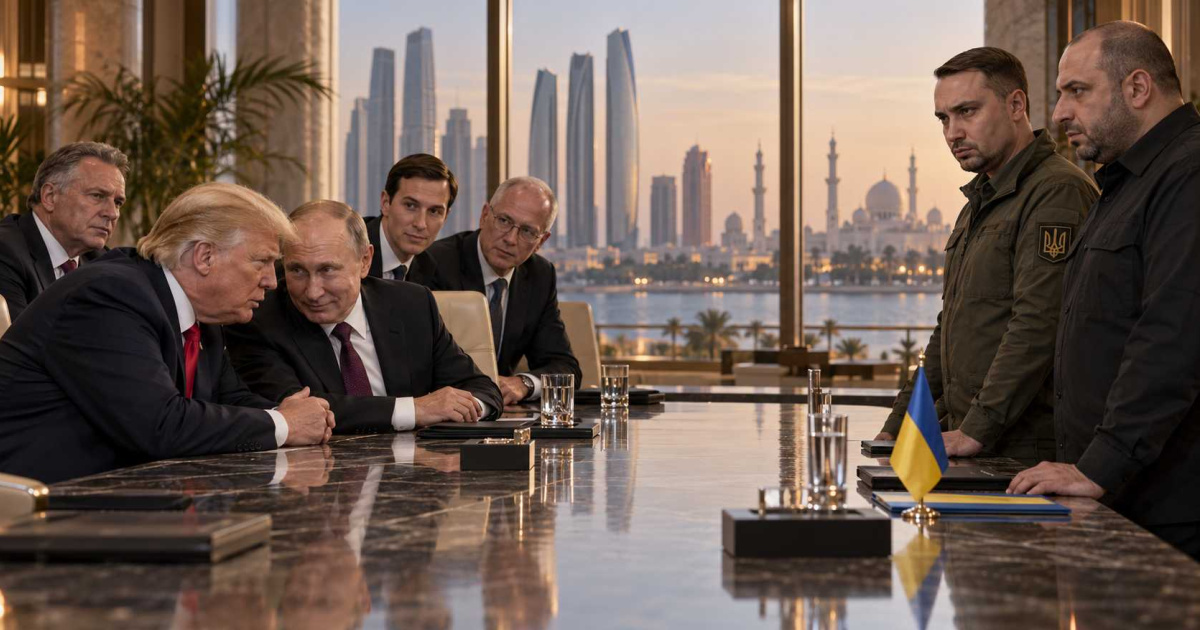
Zelensky’s public appeal to the Pentagon signals that the problem has moved beyond logistics and become a matter of political decision-making in the White House. In other words, Trump is deliberately leaving the Ukrainian capital without protection against russian missiles in order to strengthen moscow’s position in the negotiations. Zelensky’s public acknowledgment of this fact ahead of the talks in Abu Dhabi is an alarming signal: the president seems to be justifying himself in advance to his people and partners for Ukraine’s deteriorating negotiating position and possible compromises.
At the same time, a question arises: if moscow received a diesel deal and a postponement of sanctions from Trump in exchange for its willingness to return to the negotiating table, perhaps Kyiv should also try to set its own conditions, demanding Patriot missiles as a prerequisite for sending its delegation to Abu Dhabi? Especially since European partners will not be there, while Kyiv is interested in their participation.
2. Yesterday, Finnish President Alexander Stubb and Norwegian Prime Minister Jonas Gahr Støre held a phone conversation with putin that lasted about an hour and a half. The initiative came from Stubb and Støre following consultations with Kyiv. The topic was “diplomatic efforts to end the war”. After the conversation, Stubb briefed Zelensky on its outcome for about 30 minutes. In his evening address, Zelensky expressed Kyiv’s interest in European participation: “In November, we expect a trilateral format: Ukrainian, American, and russian representatives. It is important that Europe also participates in all diplomatic efforts”.
The conversation between two leaders of the Nordic Council and putin indicates growing concern in Europe that Washington and moscow will formulate the terms for ending the war without European involvement. In other words, Europe understands that, like Ukraine, it could find itself not at the negotiating table but on Trump’s and putin’s menu. This is particularly telling following the latest statements by putin and Ushakov, which revive moscow’s 2021 demand that NATO roll back to its 1997 borders. However, the Danish prime minister’s dissatisfaction and Stockholm’s restrained reaction to the call indicate that there is still no unified European position on engaging with moscow. Perhaps Brussels is waiting for Witkoff and Kushner’s American business-negotiation format to run its course, which could happen after Trump’s party is expected to lose the November 4 congressional midterm elections. This once again raises the question of whether it makes sense for Kyiv to participate in trilateral negotiations with the russian federation and the United States on that very day.
3. Following the resumption of Houthi attacks on targets in Saudi Arabia, Brent crude traded at around $115–116 per barrel, marking a weekly increase of 6%. Meanwhile, the Associated Press published an investigation indicating that the Iran-backed Houthi groups receive information from russian reconnaissance satellites through Iranian advisers, helping them strike Saudi oil facilities.
If the russian federation’s involvement in facilitating these attacks is confirmed, it would mean that moscow is actively contributing to the weakening of the United States’ regional partners and the deepening of the Middle East crisis, which allows it to double its oil revenues and secure the lifting of sanctions by Trump.
This could affect the balance of power in the United States, create new vulnerabilities for Trump, and, accordingly, change his attitude toward putin.
Overall, russian-Iranian intelligence cooperation shows that the connection between the wars in Ukraine and the Middle East is much closer than it appears. Ukraine could also become a bargaining chip for Trump in this game. This, once again, underscores the need for Kyiv to transform the trilateral format into a quadrilateral one, with the participation of the EU.
By Serhii Harmash, editor-in-chief of OstroV