
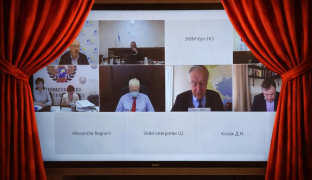



The practice of hybrid negotiations on a
hybrid settlement of a hybrid conflict
Moscow's diplomacy. Methods and techniques
Some of the situations I have already described illustrate moscow's diplomatic tactics at negotiations. But it seems to me that it would be more useful to examine them not from the perspective of stories, but specifically in terms of methods and techniques. This will provide a deeper understanding of the essence of diplomacy in general, and russian diplomacy in particular.
At the very first meeting of the TCG with our participation, russia's representative in the TCG, Boris Gryzlov, reprimanded me. In my remarks, I said that russia had occupied Donbas. He did not dispute the fact itself, but stated that at the Minsk negotiations, only the terminology recorded in the Minsk agreements could be used, and the word "occupation" was not there. The OSCE representative supported him.
At the time, this seemed to me like nitpicking, but if these were the rules, I accepted them. What was surprising was the very fact that the head of the russian delegation, who was mostly silent, had stooped to reprimanding an ordinary adviser to the Ukrainian delegation. But, as subsequent negotiating practice showed, the "Minsk" terminology was fundamentally (!) important to moscow. It was one of its strategic tools for verbally and cognitively reclassifying the conflict from an interstate one into an "internal" conflict, replacing the negotiating subject from russia with "Donbas" and, accordingly, replacing russia's very role in the war from a party to the conflict to a "mediator". This was supposed to lead to removing responsibility for the war in Donbas from it, and subsequently, logically, to the lifting of international sanctions.
At the same time, russia itself and its puppets from Donetsk and Luhansk systematically and deliberately violated the "Minsk terminology" rule, but for some reason neither the OSCE nor Ukraine responded to this appropriately.
In particular, they persistently called the Trilateral Contact Group, whose name was recorded in all official documents, the "Contact Group". It is clear why – by removing the number of participants from the TCG's name, it could be presented as a five-party group: Ukraine – OSCE – russia – "DNR" – "LNR". And this was precisely one of their main narratives. In that case, the "DNR"/"LNR" would immediately become parties to the conflict and subjects of the negotiations instead of invited participants. But five participants simply could not fit into the concept of "trilateral".
Certain Districts of the Donetsk and Luhansk oblasts of Ukraine (CDDLO) – the officially established name in all Minsk documents for one (!) territorial (!) unit. The russians constantly and deliberately called CDDLO "Donbas", "the people of Donbas", "DNR"/"LNR," "republics", and "a young developing state". The purpose was to cognitively reclassify a single part of Ukraine's territory – CDDLO – into two (!) different political (!) entities and change its status at the negotiations.
This was, in general, a colossal mistake by our delegation from 2014 onward – CDDLO should have been represented by a joint team of invited consultants (according to the documents, their function was "consultation and coordination") from Donetsk and Luhansk. Instead, we essentially had to deal with two delegations representing two (!) different political (!) quasi-entities.
There you have the price of words in diplomacy! Moreover, russia's use at the negotiations and in the information space of the terms "Donbas" and "the people of Donbas", which were supposedly personified by participants from the "DNR"/"LNR," cognitively extended their "powers" from the limited territory of CDDLO to the entire territory of the Donetsk and Luhansk oblasts, most of which was controlled by Kyiv…
The moscow puppets invited from CDDLO themselves were referred to by the russians exclusively as "CDDLO delegations", "heads of delegations", "official representatives", "DNR Foreign Ministry" and "ministers". In other words, their status in the negotiations was verbally elevated, which de facto, through verbal manipulation, actually grew into their status as negotiating subjects.
If we take the original documents of the so-called "Minsk agreements", namely the Protocol and the Memorandum on its implementation (September 2014), both are titled "...following the consultations of the Trilateral Contact Group". The moscow vocabulary, however, transformed the consultations between Ukraine, the OSCE, and russia within the TCG into a "direct dialogue between Kyiv, Donetsk and Luhansk", thereby "reclassifying" the interstate conflict as an internal one.
Thus, the "Minsk terminology rule", with the OSCE moderators' tacit consent, was applied for some reason only to Ukraine. Eventually, this became established practice in the negotiating process...
This technique is called "asymmetric vocabulary control". "Minsk terminology" was applied as a rule when it was necessary to prohibit the word "occupation", and ignored when russia itself used "republics" and "intra-Ukrainian conflict", which, naturally, did not appear in the Minsk documents.
Moreover, the substitution of concepts occurred even at the level of the very term "Minsk agreements". Russia systematically and persistently referred to only the "Package of Measures for the Implementation of the Minsk Agreements" of February 2015 as the Minsk agreements. Although even this title speaks for itself. If this is the "Package of Measures for the Implementation of the Minsk Agreements...," then the Minsk agreements themselves must, consequently, be something else. Namely: the Minsk Protocol of September 5, 2014, and the Minsk Memorandum of September 19, 2014, both of which were also signed by russia. But it was precisely these documents that moscow wanted to "forget."
The purpose of such a fragmentary "amnesia" was to neutralize Point 4 of the Protocol, which provided for the "creation of a security zone in the border areas of Ukraine and russia". That is, on the territory of the russian federation, which clearly indicates the party to the conflict – on the land of the "mediator", it would make no sense to create a security zone controlled by the OSCE. In addition, Point 1 of the Protocol refers to a "bilateral ceasefire". Not a trilateral one, as it would have been if Ukraine-"DNR"-"LNR" were meant, but specifically bilateral – Ukraine-russia...
Here I must say that, to the credit of the Ukrainian delegation, we consistently insisted on understanding the "Minsk agreements" as a package consisting of three documents. However, this did not prevent moscow and its puppets from pursuing their line. They were helped by the UN Security Council resolution of February 17, 2015, which granted the "Package of Measures..." the status of an international legal document binding on the parties to the conflict. At the same time, the resolution DID NOT NAME these parties!
And it is probably unnecessary to say that the author of the resolution was russia. Which also violated the voting procedure stipulated by the UN Charter. It clearly states that "a party which is a party to the conflict" must abstain from voting when a decision is being adopted...
To the shame of Ukrainian diplomacy and our Western "partners", especially the Security Council members: the United States, France, and the United Kingdom, – the russian draft was adopted unanimously. Ukraine also voted for the resolution, although it accompanied its vote with a statement from the Foreign Ministry emphasizing that the document did not relieve russia of responsibility as a party to the conflict. However, unlike the Package of Measures, this statement did not become an annex to the UN Security Council resolution...
It must be acknowledged that the February 2015 UN Security Council resolution was an unequivocal diplomatic victory for russia.
Thus, a practice of double reality developed during the negotiations on the implementation of the "Minsk agreements" – each side understood the subject of the negotiations in its own way. And each had grounds for doing so...
But let us continue our review of moscow's verbal and cognitive acts of sabotage. One of the most successful such operations is the myth that firmly established itself in the minds of Ukrainians (and not only them) that the Minsk agreements provide for enshrining a "special status of Donbas" in the Constitution of Ukraine. This, along with amnesty for militants, was the main factor behind public distrust of the Minsk process and its negative image. Moreover, this factor operated everywhere, from the streets to parliament and the expert community.
In fact, Point 11 of the Minsk Package of Measures provided for "carrying out constitutional reform in Ukraine, with a new constitution coming into force by the end of 2015, envisaging decentralization as a key element (taking into account the specific features of certain districts of the Donetsk and Luhansk oblasts, agreed with representatives of these districs)... "
In my opinion, the difference is obvious: decentralization TAKING INTO ACCOUNT the specific features of certain districts (specific features can be taken into account in different ways) and "enshrining a special status in the Constitution". Moreover, although moscow often repeated this myth in the media, it never officially used such wording in documents. That is, it was created rather to entrench it in the public consciousness of Ukrainians, with the aim of fueling the "betrayal mania", than with any real expectation that it would be implemented.
Another moscow diplomatic trick consisted of russia appointing itself as an arbitrator.
"We will accept any consensus decision between the CDDО, CDLO, and Ukrainian delegations" – this was the standard phrase russian representatives used in response to a question about russia's position on one issue or another.
Note that with this little sentence, moscow not only absolved itself of responsibility for the conflict and the course of the negotiating process to resolve it, but also "legalized" two false entities at once: the "delegations" and two entities – CDDO and CDLO – instead of one CDDLO.
The continuation of this tactic was russia's refusal to prepare draft documents discussed at the TCG. "Peace plans", "road maps", a draft law on the specific features of local self-government in CDDLO... – all of this was generated only by Ukraine and the "delegations" of the "DNR"/"LNR". Although moscow allowed itself to make comments on our draft documents, it did not prepare its own as a "non-party to the conflict" – instead, it spoke through the mouths of "Donetsk" and "Luhansk".
I remember how, in response to yet another request by Kravchuk for russia to officially present an action plan from the russian delegation to the TCG, Gryzlov said: "If such a plan were to appear, it would constitute interference by Russia in Ukraine's internal affairs"... And this is the same person who constantly demanded that Ukraine change its laws, resolutions of the Verkhovna Rada, and even the Constitution. I am not even talking about russian troops on the territory of Ukraine – they, of course, did not interfere in Ukraine's internal affairs.
So we get a scheme with a built-in veto, but without any responsibility. They did not even want to accept any documents from us directly: "we support it, but please pass these copies to Ms. Nikanorova and Deinego".
Another interesting technique is "slips of the tongue", "diplomatic carelessness". For example, at one of the meetings, on September 17, 2020, an utterly brazen Gryzlov instructed Heidi Grau, the Special Representative of the OSCE Chairperson-in-Office in Ukraine, to give the floor to the "foreign minister" of the "DNR": "Give Nikanorova the floor, it's their territory".
The latter also "slipped up", telling the First President of Ukraine that they were a "young developing state" and had better things to spend their valuable time on than negotiations with Ukraine... Leonid Kravchuk, who had not expected such audacity, did not even understand what she meant and decided that Nikanorova had called Ukraine a "young developing state". By the way, regarding "their territory", he demanded that Gryzlov apologize if it had been a slip of the tongue, or provide an explanation if it was the official position of russia. Of course, no one apologized or provided any explanation. The day before, Gryzlov's subordinate Dmitrievskyi also stated at a meeting of the political subgroup that "Ukraine is in conflict with CDDLO". And there were countless such "slips". "Well, I am not even writing about russia being a 'non-party to the conflict'. We are being systematically accustomed to this, while the OSCE, and indeed we ourselves, diplomatically 'go around it'", I wrote on my Facebook after that TCG meeting.
This technique is called – testing a norm through "slips of the tongue". Seemingly one-off phrases ("their territory", "states", "Ukraine is in conflict with CDDLO", "intra-Ukrainian conflict") are neither officially confirmed nor refuted. But they remain in the record of the negotiations, become a precedent, and shape "negotiating practice". This is how the participants in the process are gradually accustomed to a new framework. After all, it is words that shape reality: "as you name the boat, so shall it sail". Moscow has absorbed Goebbels' words better than anyone – words he plagiarized from Chateaubriand: a lie repeated many times becomes the truth...
Another negotiating trick used by moscow is deflection and a condescending tone toward the opponent.
As an example, I will cite the TCG meeting of November 24, 2021. Here is what I wrote about it afterward on my Facebook page.
"It seems that russia has finally plunged the Minsk process into a coma. Although the russian delegation was unusually active both yesterday (at the political working group) and today. But active not in terms of working to resolve the conflict, but in terms of statements that russia will precisely not work in this direction because it is 'not a party to the intra-Ukrainian conflict'. For example, during negotiations in the Trilateral format (OSCE, Ukraine, russia), russia's plenipotentiary Gryzlov refused to answer questions concerning the actions of russia itself. He immediately demanded that his puppets from Donetsk and Luhansk be invited, as if they could comment on putin's decree recognizing goods from CDDLO, or on russia's failure to fulfill its obligations to provide the OSCE SMM with unhindered access to the territory of Ukraine occupied by russia. Russia even refused to support an appeal to the International Committee of the Red Cross so that the ICRC could examine the circumstances surrounding the death of a 37-year-old Ukrainian citizen in a penal colony in Makiivka, who was on the exchange lists. In other words, Gryzlov ignored practically all the questions and proposals put forward by Ukraine to russia.
But if they do not want to listen to something, that does not mean that we will not talk about it! Moreover, in response to Gryzlov's repeated statement that 'the parties to the conflict are Ukraine and CDLO and CDDO', perhaps for the first time during my year and a half in the TCG, I heard a clear statement from acting head of the Ukrainian delegation Andrii Kostin that RUSSIA IS A PARTY TO THE CONFLICT (!). Previously, we diplomatically stated that russia was a party to the TCG... I must say, Gryzlov was somewhat taken aback by such a statement: 'such a position will not lead to a settlement of the intra-Ukrainian conflict'. He even suggested that Kostin 'consult with his leadership...' regarding such statements.
Mr. Gryzlov, if the conflict were 'intra-Ukrainian', we would have sorted it out without you! Without your interference in our 'internal' affairs! Except there are no 'miners and tractor drivers' there; there are russian weapons, russian passports, russian rubles, and russian flags...
Of course, the cynicism is simply off the charts. Gryzlov constantly quotes the Minsk agreements, but what he quotes is precisely not in their texts. In other words, the head of the russian delegation is simply lying, knowing that we know he is lying, and this is called diplomacy in russia?! Still, what position can Gryzlov take if putin clearly stated a week earlier: "Nowhere in the Minsk agreements does it say that russia is a party to the conflict. We have never agreed to this and never will. We are not a party to it"! I would argue with this statement, specifically referring to the Minsk Protocol, but there is no point in arguing with them".
What is the trick? – Questions about russia's actions (the decree recognizing goods from CDDLO, SMM access) are redirected to stooges. An inconvenient formulation by the acting head of the Ukrainian delegation is presented as his personal initiative, for which he had not been authorized by the leadership. By the way, a similar situation occurred in February 2021. At the time, russian representative in the TCG political subgroup Aleksei Dmitrievskyi called the same statement by Kostin an "exceeding of authority". In other words, this is not an isolated case, but moscow's playbook: if an inconvenient question is asked, do not answer it, but discredit the person who asked it by calling them incompetent! And at the same time make the opponent believe that his superiors hold a different opinion, thereby putting psychological pressure on his counterpart...
By the way, the last paragraph of the Facebook post I quoted above pointed to another rather nasty practice of kremlin diplomacy: "Gryzlov constantly quotes the Minsk agreements, but what he quotes is precisely not in their texts".
It should be said that fabricated quotations from documents, calculated on the assumption that not everyone remembers their exact wording and that a response is needed right now, are one of the main tools of russian diplomacy. And Gryzlov was not the only one to use it.
Thus, in July 2021, the kremlin's "Minsk" curator, Deputy Head of the Presidential Administration of russia Dmitry Kozak, said in an interview with the French publication Politique Internationale:
"To exclude Donbas from the negotiating process means revising the very meaning and substance of the Minsk agreements. The Package of Measures states that the only subjects of the settlement with the right to a decisive vote are Ukraine and Donbas, without any mediators and without reservations.... Without a radical revision of the Minsk agreements, without a decision by the UN Security Council, it is impossible to deprive Donetsk and Luhansk of their own negotiating mandate".
The same thing, and almost in the same words, was literally stated a week later by Boris Gryzlov in a statement following the TCG meeting: "The discussion about the parties to the conflict ended more than six years ago with the signing of the Minsk agreements, which state that only Ukraine and Donbas are parties to the conflict and subjects of its settlement. The UN Security Council confirmed Donetsk and Luhansk's mandate to settle the conflict in its resolution. Therefore, without the participation of the UN Security Council, it is impossible to deprive representatives of Donbas of their mandate solely within the Contact Group or in the Normandy format".
Here we see synchronized references with the marker of certainty to two documents at once: the "Package of Measures" and the UN Security Council Resolution. And both are false! Of course, you will not find the word "Donbas" in either the Package of Measures for the Implementation of the Minsk Agreements or, even more so, in the UN Security Council Resolution. Unfortunately, there is no designation of the parties to the conflict there either. And certainly, there is no "negotiating mandate of Donetsk and Luhansk" or "Donbas"... This is precisely an example of when black is called white. But no one, obviously, checked the truthfulness of these words. What matters is that they were released into the international information space.
Moreover, this was precisely a coordinated action, since we can see the repetition of false narratives by different kremlin officials almost word for word...
"Putin's article, Kozak's clearly orchestrated interview (published the day after his boss's 'historic opus'), Shoigu's order to study putin's article during political training sessions in the russian Armed Forces, Gryzlov's statement – all of this is evidence of a new phase of the war against us – a semantic one. And it is more dangerous than a hot war. Because people load the guns, and people only truly do something well when they believe in it. Therefore, if people are convinced that by killing someone they are doing good, that the meaning of war is not killing but salvation (the Inquisition burned people at the stake not as punishment, but 'to save the souls of sinners'), they will kill enthusiastically, without moral restraints.
I do not want to jinx it, but I clearly see signs in this informational and ideological filth of a special operation aimed at splitting Ukrainian society and preparing for a new escalation of russia's hot war against Ukraine... By distorting meanings – historical, political, diplomatic – moscow is preparing the world to justify the 'justice' of this war", I wrote at the time (22.07.2021) on my Facebook.
It should be said that, unlike moscow, our "professionals" from the Office of the President treated words extremely carelessly. And at times they themselves disseminated formulations in the media space that reinforced russia's narratives about its non-involvement in the conflict. Here is one example. Ukrinform news agency published this news article on September 7, 2020:
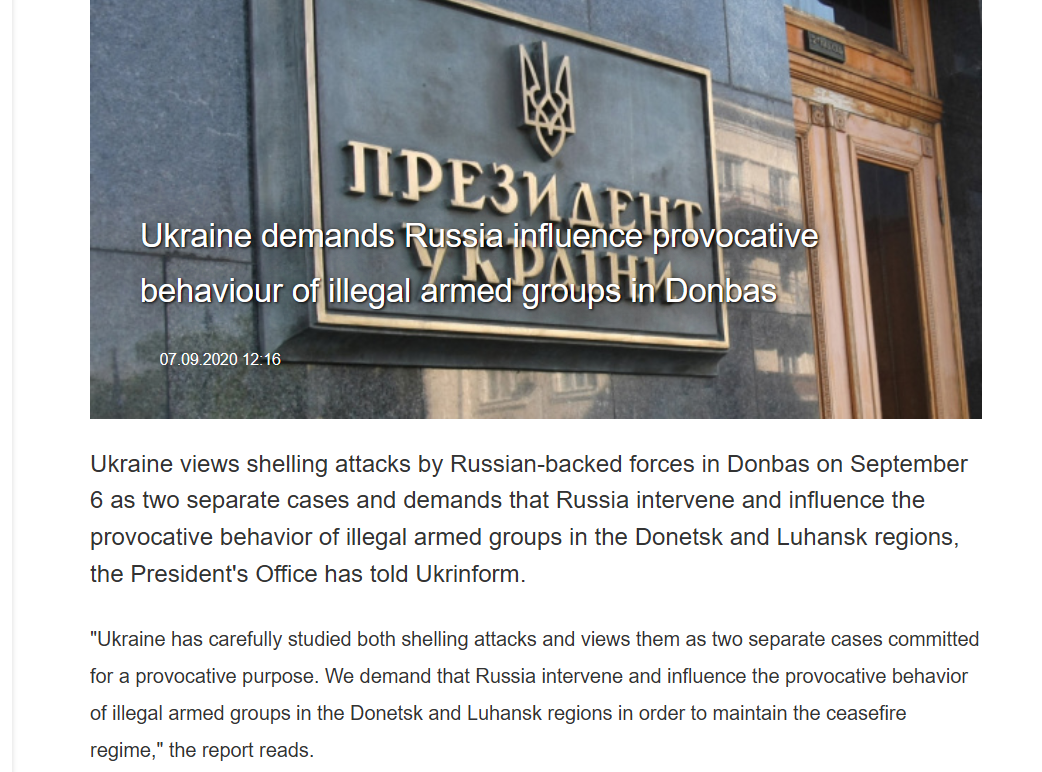
"We demand that russia 'intervenes and influences'? Seriously? Are we already separating russia from the 'DNR-LNR' militants? Are we already allowing for the possibility that they themselves decided to kill us using weapons purchased from the 'military supply store'? The Joint Forces Operation Command writes about ceasefire violations by the 'armed formations of the russian federation', while the Office of the President still cannot decide who Ukraine is at war with?
I understand that there should be diplomacy, room for maneuver, and so on... But when you write something like this, think about the fact that people in Ukraine will read it too, not just in moscow...
And this – the President is 'extremely concerned about provocative shelling and the tension in the situation'... Our 'Western partners' have already worn us out with their 'extreme concern' against the backdrop of our deaths. Guys from the Office of the President, throw this expression out of use. Don't put it in the president's mouth. It already sounds like mockery", I commented on the work of Zelensky's Office on Facebook at the time.
To be continued
By Serhii Harmash, editor-in-chief of OstroV