
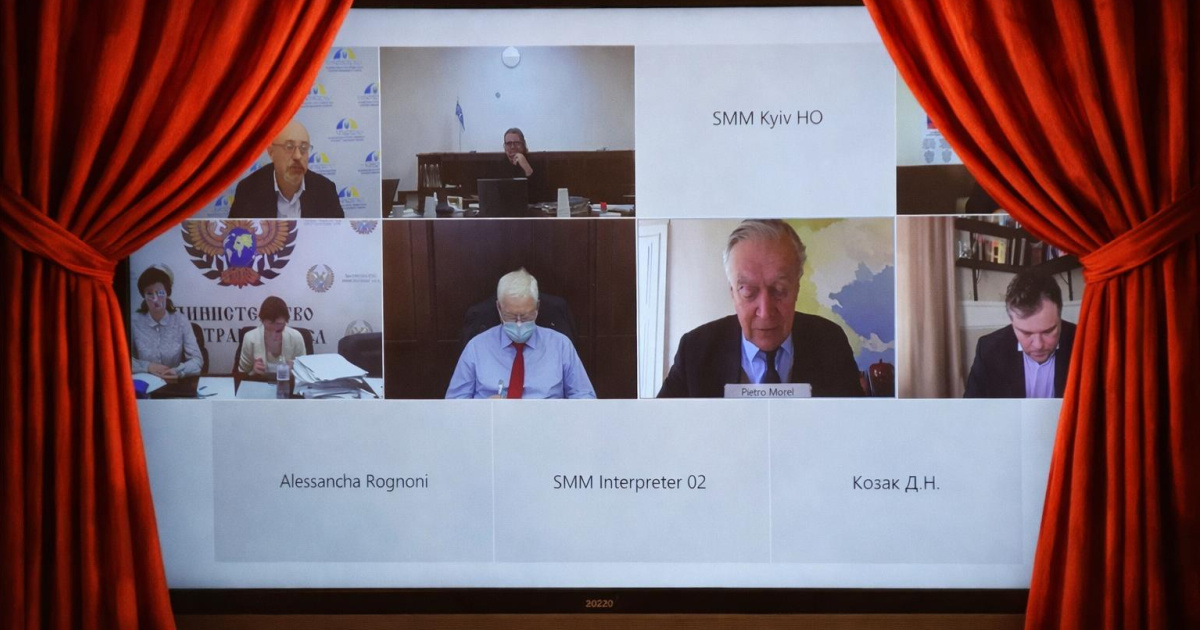
The Popasna city community is the only one in the Luhansk oblast whose territory — that is, all the infrastructure, the entire housing stock, every single thing! — has been completely destroyed down to the ground. OstroV regularly invites its readers on virtual “tours” of the ruins of Popasna. Back in 2022, this territory turned into a huge landfill of large-scale construction debris, among which are craters and explosives. And the remains of those killed, whom — we will allow ourselves this pessimistic prediction — will never be removed from here, identified, or buried.
In the other communities of the region, at least something remains in material terms — despite the occupation, severe destruction, and hostilities. But as for the Popasna area, apart from the horrific landfill mentioned above, all that remains of it are people now scattered across the planet Earth. In some regions, they come together in person, as people now say, “offline”, and bring other displaced people from the Luhansk oblast together around them.
A bit of official data and figures: hubs, healthcare, education, employment, etc.
Deputy Head of the Popasna City Military Administration Olena Lahutina emphasizes that after 2014, Popasna was a frontline city — one of the cities in the Luhansk oblast that, until May 8, 2022, was located 7 km from the line of combat and the territory not controlled by the Government of Ukraine.
“The total population of the Popasna city community before russia’s full-scale invasion of Ukraine was 24,600 people. Now, around 250 people remain in the occupied territory of the Popasna community (essentially, in the ruins, as we periodically write about — OstroV)”, - says Olena Lahutina.
She notes that the Popasna City Military Administration currently has three humanitarian hubs — in the cities of Kharkiv, Cherkasy, and Samar (formerly Novomoskovsk) in the Dnipropetrovsk oblast. Overall, they provide services to 12,000 internally displaced persons.
“By the way, the Popasna City Military Administration was the first to come up with and organize the work of a humanitarian hub, first in the city of Bakhmut, then in Samar, and later in other cities as well”, - emphasizes Olena Lahutina.
The Popasna City Military Administration currently employs 40 civil servants who did not betray Ukraine. All of them have internally displaced person status. Significantly, 99% of them are residents of the Popasna community itself.
“In the administration and the municipal institutions subordinate to it, 97% of the employees are residents of our community, while the rest are also internally displaced persons”, - says Lahutina.
As for municipal enterprises in the Luhansk oblast, public activists often ask what, under the conditions of relocation, organizations such as housing maintenance offices or water utilities can do. In some communities, they are either involved in building fortifications (as in Lysychansk) or have been completely repurposed, retaining only their name. For example, the Severodonetskvodokanal municipal enterprise manufactures drones for the Armed Forces of Ukraine.
The relocated Popasna community still has the Specialized Municipal Enterprise.
“It employs just four people, who are directly involved in the operation of the humanitarian hubs and in supporting internally displaced persons with technical and household issues”, - says the deputy head of the City Military Administration.
As for education — although virtually everything in the Luhansk oblast operates online, the Popasna community has managed to organize in-person work at a kindergarten. Thus, the Vrubivske Preschool Education Institution (the director and educator of the institution are the same person) operates offline in Kharkiv as a children’s space. It holds school-preparation classes, entertainment and holiday events, etc. It serves children not only from Popasna but from all across the Luhansk oblast.
As of September 1, 2026, three general secondary education institutions will operate under the Popasna community. These are the V. Shulyk Popasna Lyceum, the Popasna Gymnasium, and the Olympic Education School — Popasna Gymnasium No. 21. A total of 97 teachers are involved in their work. There are 770 children studying here, 413 of whom remain in Ukraine, while the rest are abroad.
The Inclusive and Resource Center operates remotely.
The Center for Extracurricular Education operates in a mixed format. In addition to distance learning, in-person activities are held in Kremenchuk (the Poltava oblast), Stryi (the Lviv oblast), and Cherkasy. We will return to this issue below.
Doctors from the Popasna community receive patients in several regions of Ukraine.
“At the Popasna City Multidisciplinary Hospital municipal non-profit enterprise, seven doctors work both offline and online”, - the City Military Administration reports.
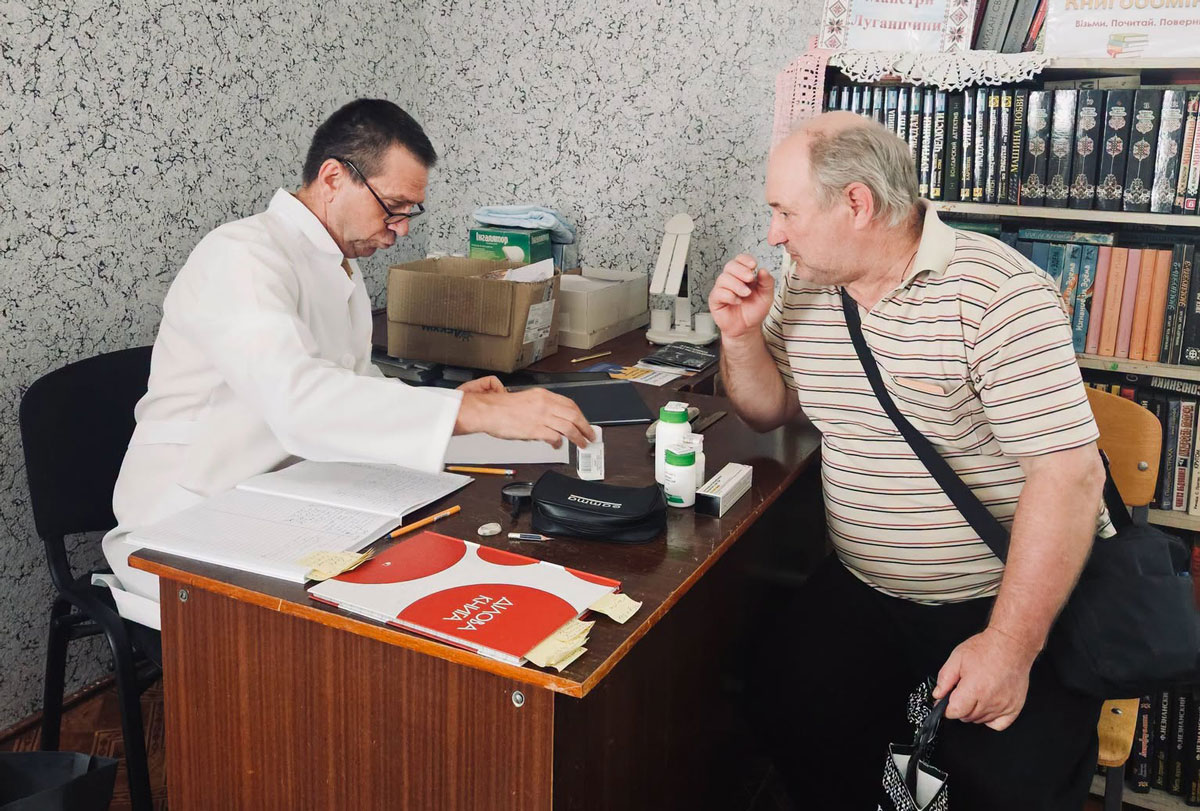
Outreach consultations by doctors from Popasna district in the Dnipropetrovsk oblast
In particular, a psychiatrist receives patients at the Starobilsk City Military Administration’s hub in Lviv, a neurologist at the Popasna City Military Administration’s hub in Kharkiv, a general practitioner at the Popasna City Military Administration’s hub in Samar, and a gynecologist at the Hirskyi City Military Administration’s hub in Khmelnytskyi. In Kropyvnytskyi, an endoscopist, an ultrasound room, as well as an oral and maxillofacial surgeon, a pediatric dentist, and a general dentist are working.
The Primary Health Care Center municipal non-profit enterprise has opened a general practitioner’s office in Kharkiv, where two general practitioners currently work. In addition, a general practitioner from this enterprise sees patients at the Hirskyi community’s hub in Poltava, while a nurse provides assistance at the Popasna City Military Administration’s hub in Cherkasy.
At the humanitarian hub in Cherkasy, the Center for the Provision of Social Services municipal institution also operates offline.
The Popasna Center for Comprehensive Rehabilitation of People with Disabilities “Leleka” municipal institution continues to operate both online and offline. Online services are provided to 26 children and 5 young people with disabilities. They work with a rehabilitation teacher and a speech therapist. Corrective classes for children living both abroad and in Ukraine are held twice a week.
“Our institution has signed memorandums of cooperation with the Religious Mission ‘Caritas-Spes Ukraine’ and the coordination center of the Lozno-Oleksandrivka Rural Military Administration of the Svatove district, the Luhansk oblast. Under these memorandums, the center’s specialists provided rehabilitation services to children and young people with disabilities from the Luhansk oblast — 60 people in total — as well as to children and young people from different parts of Ukraine, reaching 262 children and 260 parents. At the Lozno-Oleksandrivka Rural Administration coordination center, we established a social workshop for minor repairs of items, which was visited by dozens of displaced people from the Luhansk oblast. In addition, we held and continue to hold workshops, events, and celebrations for children and adults, and equipped a space for corrective activities with children who have disabilities or are at risk”, - the “Leleka” center says.
Thus, the work of the Popasna City Military Administration’s humanitarian hubs actually covers three cities, while medical and social services are provided in a somewhat larger number of settlements.
To reach even more regions specifically through face-to-face communication among people from the same community, the Popasna City Military Administration launched the “Family Meetings” project. This is a personal initiative of administration head Mykola Khanatov. In particular, administration employees organize outreach meetings with community residents in various settlements where there are no humanitarian hubs. These include Zhovti Vody, Kryvyi Rih, Mahdalynivka, and Synelnykove in the Dnipropetrovsk oblast, Kremenchuk in the Poltava oblast, Oleksandriia in the Kirovohrad oblast, Stryi in the Lviv oblast, Uzhhorod, and others. Face-to-face communication with displaced people — residents of Popasna — not only provides psychological support but also makes it possible to resolve problems more quickly and meet certain needs of internally displaced persons whenever possible.
A significant part of the Military Administration’s work is traditional for all relocated communities of the Luhansk oblast and is officially covered through certain resources.
“Comprehensive social support programs are available for community residents and, in particular, military personnel. Every Monday, a commission for providing financial assistance operates. Information and contacts are constantly published on the official City Military Administration website and its Facebook page. Under these programs, we provide assistance with surgical procedures, treatment of chronic diseases, and, for military personnel, with needs related to their service and medical treatment. We support elderly people, people with disabilities, students, schoolchildren, and members of the Youth Council”, - says Olena Lahutina.
Special attention is paid to the employment of internally displaced persons. Thus, in 2024, OstroV reported that more than thirty displaced people from the Luhansk oblast took part in a recruitment event for demining positions at the Popasna humanitarian hub in the Dnipropetrovsk oblast.
“In 2024, we cooperated with the international humanitarian organization ‘The HALO Trust’ in the field of humanitarian demining. In total, work was carried out with 1,117 residents of the Luhansk oblast”, - the Popasna City Military Administration says.
As for employment, the community also has a Comprehensive Program for Supporting Veterans and Their Family Members in Creating or Developing Their Own Businesses, as well as a Comprehensive Program for Supporting Internally Displaced Persons of the Popasna City Territorial Community. They are aimed at facilitating employment, developing entrepreneurship, and providing financial support to community residents.
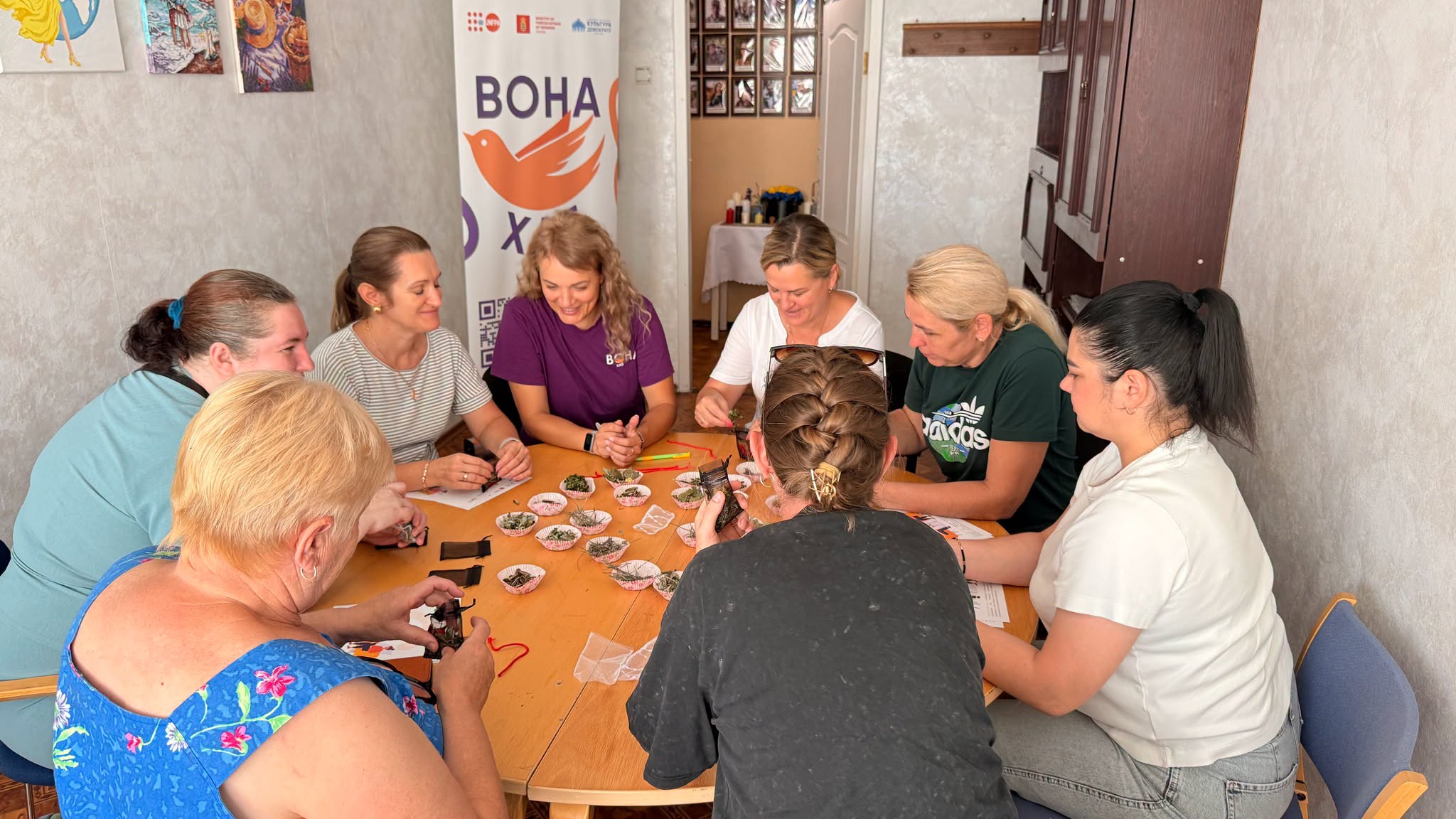
Samar, August 2026. At the Popasna City Military Administration’s humanitarian center, women are provided with consultations on retraining and employment
Beyond the official figures: promoting their Popasna through tears and art
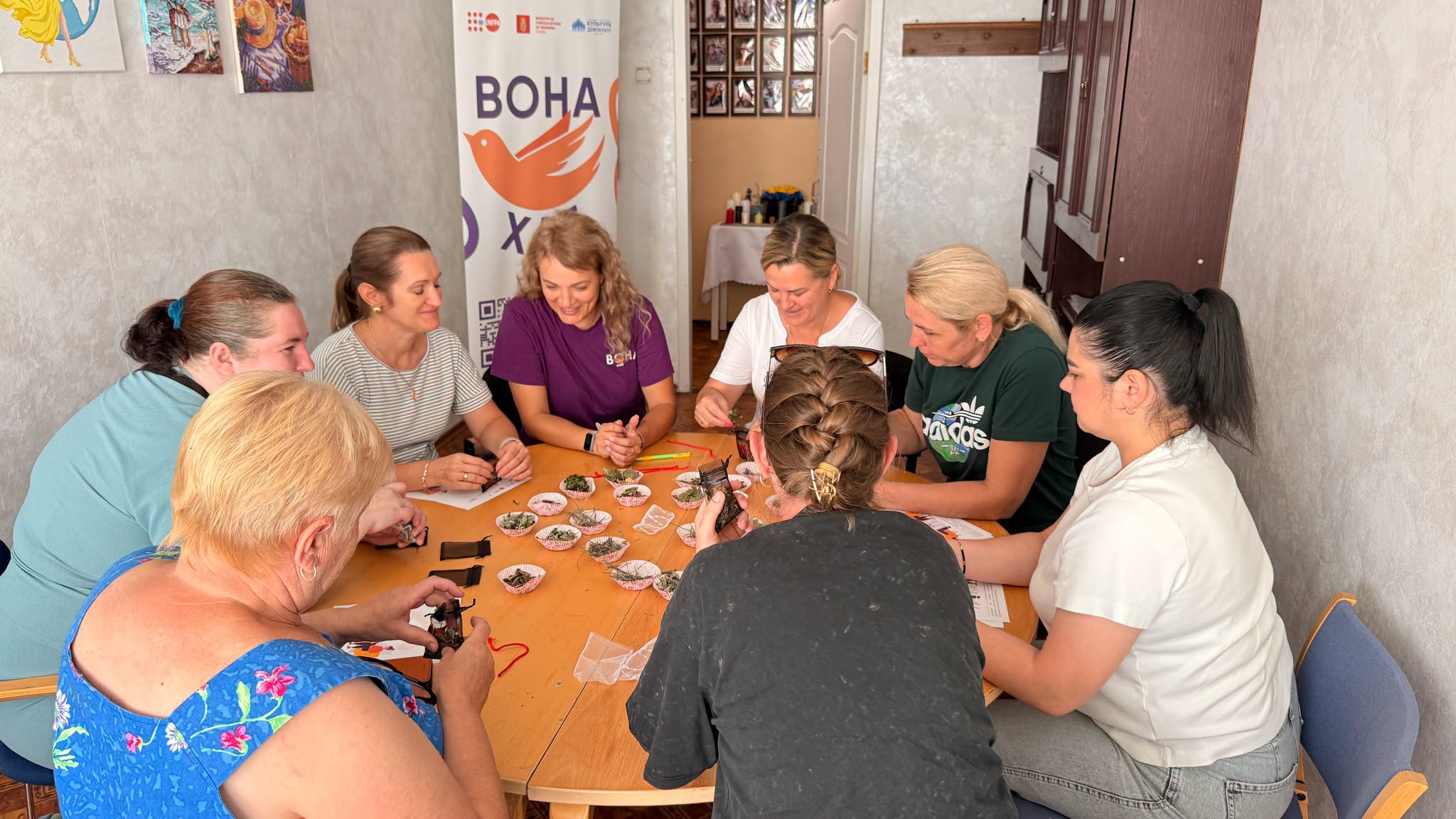
It is impossible to visit all the creative activity centers for Popasna residents mentioned above, scattered throughout Ukraine — not only while preparing a single article, but in principle. The author of the article visited the humanitarian hub in Cherkasy and attended the “Motanka Doll — the Code of Ukrainian Identity” workshop, conducted by Olesia Lavrenko, head of the “Useful Little Things” club at the Popasna Center for Extracurricular Education.
“I have been working with children at the Popasna community humanitarian hub in Cherkasy since 2023. Both displaced children and local children attend the classes. There aren’t that many students from the Luhansk oblast, but they are there”, - Olesia says.
When the full-scale war began and physically destroyed Popasna almost immediately, Olesia’s daughter, Zlata, was seven years old, and she remembers everything. Including her hometown — the way it was before the russians arrived. The family has now lived away from the Luhansk oblast for the fifth year, but Olesia says: “Every day we remember our Popasna and all that wonderful life we had”. When speaking about her city, she always adds this word — our Popasna. And in most conversations — at work, with neighbors, at workshops, etc. — she adds on almost any occasion: “Back home in Popasna…”
“Most of the children who attend the club do not know our native Popasna. But I constantly remember my city. I tell the children about the activities that were held at our Popasna Center for Extracurricular Education…” - says Olesia Lavrenko.
Now she describes herself as an educator and craftswoman. Over four years of working after relocation, her approach to teaching has changed. Significantly, lately the children have preferred to say not “we’re going to class” or “to the club”, but “we’re going to the workshop”. According to Olesia’s observations, the children have become more relaxed. “At the workshop” they learn to make all sorts of little things that fall under the concepts of handicrafts and decorative and applied arts.
“Although everything seems to have remained the same, a touch of new creativity and a different atmosphere have appeared. Whatever they call the classes — the main thing is that they leave them happy. By the way, they love taking part in nationwide and regional competitions”, - the craftswoman says.
The motanka dolls that came from her hands during her life in Cherkasy are difficult to count. They do not stay at Olesia’s home or in the hub or club premises — instead, they travel as gifts from Popasna all across Ukraine and far beyond its borders.
At the “Across the Steppes to Our Own” event in Cherkasy, Olesia Lavrenko said:
“In our Popasna, I was the head of a club at the Popasna Center for Extracurricular Education. I taught children to do things that, you know, don’t really oblige you to anything… It’s art where you simply enjoy what you’re doing. I’ll show you one of these things now — it’s a motanka doll. …The motanka dolls you see now are just a small part of what I can show you today. As usual, whenever someone is going somewhere: ‘Olesia, can you make a motanka doll? We’ll give it to someone as a gift’. And so it goes on and on for me… The motanka dolls travel abroad and probably all across Ukraine. When I create them, I put my soul and my emotions into them, because a doll like this should only be made in a good mood, with positive thoughts. I believe that everything you put into making them becomes part of them. Your thoughts, your vision of what she will look like. I like them to have flowers. Probably because at my mother’s house in our Popasna district, in my home, there are so, so many flowers... It’s just such a pain (cries). And what you see on the motanka dolls — wreaths of flowers — is probably a little piece of the home where our soul remained. A motanka doll is probably a soul”.
“The main detail is the head. Where do we start? We take a piece of fabric like this and start twisting it, twisting it, wrapping it… You already have everything prepared; I’m just showing you how it’s done. You twist it: the more fabric you have, the bigger the head will be. But I’ll let you in on a secret: my motanka dolls have synthetic padding inside their heads. That way, less fabric is used”.
With her experience, skills, and demand for her work, Olesia could easily find a job anywhere in Ukraine. Especially since the country is experiencing a shortage of workers. The same applies to the Popasna doctors, teachers, and other specialists mentioned above. Yet they all stubbornly hold on to the word “Popasna” in their employment records.
“For me, working specifically in this organization is precious because it connects me with my native home. And if I stop working specifically in the Popasna community, that last connection I have with my city will be severed”, - says Olesia Lavrenko.
By Yuliia Sabaieva, OstroV’s journalist