

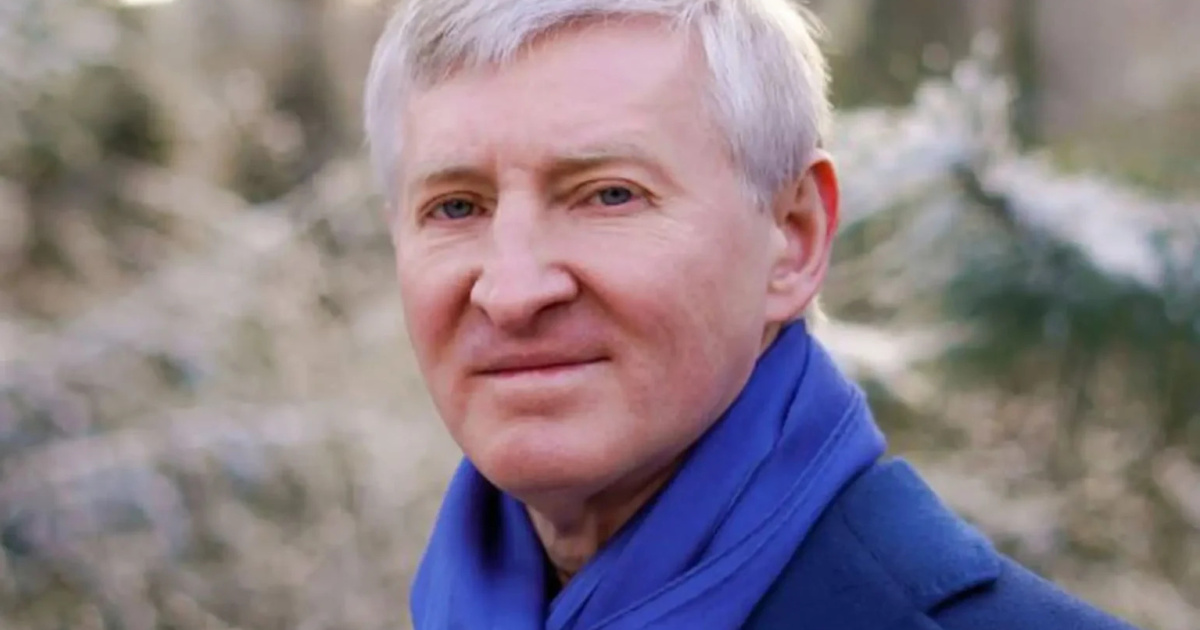
Ukraine’s richest man, Rinat Akhmetov, gave his first interview since the start of the full-scale war in Ukraine. And although The Guardian published it in its sports section as a conversation with the president of the Shakhtar football club, it was Akhmetov’s political statements that generated the greatest discussion.
He spoke about three scenarios for ending the russian-Ukrainian war and, despite the sharp conflict he had with Volodymyr Zelensky in 2021, praised the president for not fleeing the country in 2022.
Particularly resonant was the information about his support for Azov fighters during the defense of Azovstal and his phone conversations with their commander, Denys Prokopenko. This was perceived both as a political stance and as a purely human attitude toward the heroic defenders of Mariupol.
In short, it was more than an interview about football; it resembled a political manifesto by Akhmetov and his declaration of intent to participate in postwar political life.
“If the stars are lit, it means someone needs it”
Former Prosecutor General of Ukraine Yurii Lutsenko also viewed Akhmetov’s interview as a bid to take part in the political processes of postwar Ukraine. According to him, during the war, big business either remained silent or only praised Zelensky. Now, however, it has begun sending clear signals that it intends to place its bets on the next winner of the presidential election.
It should be recalled that Akhmetov spoke about three possible formats for ending the war. The first is a just peace, under which Ukraine returns to its internationally recognized 1991 borders and russia pays reparations. The second is a long-term sustainable peace, the result of which should be a free, successful, democratic European Ukraine. The third option is a false peace, toward which russia is trying to push Ukraine.
Another important point raised by Akhmetov was the gradual movement toward peace and the fact that the russian federation is at a dead end.
Similar theses were voiced by the head of the Presidential Office, Kyrylo Budanov, at the “Security Architecture” forum one day after The Guardian published Akhmetov’s interview.
Former Prime Minister Arsenii Yatseniuk also spoke on the Espreso TV channel about russia’s inability to continue the war because of the critical state of its economy.
This “general chorus” of voices about an imminent peace and the deep crisis of the kremlin was obviously not a simple coincidence. Yuriii Lutsenko believes that after the significant decline in the rating of Valerii Zaluzhnyi, caused by his transition to diplomatic work, the rating of another general associated with Ukraine’s military successes — the current head of the Presidential Office and former head of the Defence Intelligence of Ukraine, Kyrylo Budanov — began to grow rapidly. It is he who has become the new center of attraction for politicians and businessmen who are considering their participation in postwar political processes. Arsenii Yatseniuk is no exception.
According to Lutsenko, after Yatseniuk’s trips to London to meet with Zaluzhnyi failed to produce the desired results, Yatseniuk decided to focus on cultivating ties with Budanov.
However, the space around him is becoming more crowded by the day. Serhii Tihipko also has ambitions regarding him and only recently became an unpaid adviser to the head of the Presidential Office. Viktor Pinchuk has also long provided Budanov with a platform through his YES forum (Yalta European Strategy).
Surely, as peace and future presidential elections draw nearer, we will learn many new names of those who will want to politically align themselves with the rapidly rising head of the Presidential Office.
It should be recalled that during Yatsenyuk’s premiership from 2014 to 2016, the media described Rinat Akhmetov as the prime minister’s main behind-the-scenes ally. This mutually beneficial alliance was built on the government adopting decisions beneficial to Akhmetov’s business empire in exchange for media and political support. The politicians regularly held closed-door meetings, and SCM media resources provided Yatsenyuk with media exposure for a long time, helping him maintain his political rating even after his resignation.
Therefore, for Yatsenyuk, close relations with Ukraine’s richest man are not only a significant asset but also a competitive advantage over others who have their own ambitions regarding Budanov.
However, whatever plans Arsenii Yatsenyuk may be nurturing, Akhmetov will be extremely cautious in making his political choice. He is unlikely to publicly endorse any particular candidate. He already had his own difficult experience in politics when he became an MP in 2006 and 2007, having entered parliament on the Party of Regions list.
Later, Akhmetov repeatedly emphasized that coming to the Verkhovna Rada had been a mistake. His parliamentary activity was remembered not for legislative initiatives or political statements, but for systematically missing plenary sessions.
In 2012, Akhmetov did not run for office again. However, there were factions or large groups of members of parliament in the Verkhovna Rada that acted in the oligarch’s interests. There was also no shortage of officials loyal to him in the executive branch, including presidents, prime ministers, and ministers. At the same time, Rinat Akhmetov remained one of the main sponsors of the Party of Regions.
Much changed in 2014. After the Revolution of Dignity, the Party of Regions effectively ceased to exist. In the Verkhovna Rada of the eighth convocation, two parliamentary factions were associated with Akhmetov. The first was the Opposition Bloc, created in partnership with the RosUkrEnergo group (Dmytro Firtash — YuriI Boiko — Serhii Liovochkin). It is said that thanks to Akhmetov, putin’s child godfather, Viktor Medvedchuk, who intended to return to politics at the time, was kept off the Opposition Bloc party list.
Akhmetov’s second political asset in parliament was Liashko’s Radical Party. From 2014 to early 2019, its leader was practically based in Mariupol and even received the title of “Honorary Illichivets” in 2017. It was on Oleh Liashko that forces close to Akhmetov placed their bet at the start of the 2019 presidential campaign.
At the same time, the Opposition Bloc, which was aligned with Rinat Akhmetov and Dmytro Firtash, promoted Boiko. However, in December 2018, the Opposition Bloc split, forcing its backers to urgently place their hopes on yet another candidate — former top manager of the Northern Mining and Processing Plant and Metinvest Holding LLC, Oleksandr Vilkul. In the end, neither Liashko nor Vilkul even made it into the top six presidential candidates by rating.
As a result, by the 2019 parliamentary elections, Akhmetov had largely stepped away from direct party sponsorship. The Opposition Bloc — or rather the part of it that split from the Boiko-Liovochkin-Medvedchuk Opposition Platform and campaigned under the slogans of Ukrainian “industrial and economic patriotism” — received only 3% of the vote and failed to enter parliament.
Liashko’s Radical Party also failed to enter the Verkhovna Rada, and cooperation with it was reduced to a minimum after the chief radical’s failure in the presidential election.
Following the election results, Rinat Akhmetov’s visible lobby in the Verkhovna Rada of the ninth convocation consisted of seven deputies elected in single-member constituencies. Later, however, according to media reports, the “group of Chernihiv businessman Illia Pavliuk”, consisting of 30–40 Servant of the People PMs and several MPs from Batkivshchyna, entered his orbit.
After Dmytro Razumkov was dismissed from the position of Speaker of the Verkhovna Rada in October 2021, his inter-factional association “Rozumna Polityka” (“Smart Politics”) also came under Akhmetov’s influence.
After moving into opposition, the former parliament speaker rapidly gained political weight and could have become a strong alternative to Zelensky, whose relationship with Akhmetov had become extremely strained. The conflict was caused by the Presidential Office’s promotion of the Deoligarchization Law and measures affecting the oligarch’s business interests: the blocking of payments under the “green tariff”, increased freight railway transportation rates, and higher royalties on iron ore extraction.
The conflict reached its climax during a press conference at which Zelensky stated that he had received intelligence information about the involvement of Akhmetov’s representatives in preparing a “coup d’état”. In response, the businessman called the president’s accusations “an outright lie”.
The full-scale aggression of russia against Ukraine on February 24, 2022, reconciled the opposing sides. As Forbes Ukraine noted in January 2023, Zelensky appreciated that the businessman had not left the country and was providing significant assistance to the Armed Forces of Ukraine. Rinat Akhmetov himself described his relations with the authorities in his characteristic style: “There was never any confrontation on my part. That is not my policy. And since February 24, 2022, the president and I have been looking in the same direction — toward our victory”.
In his interview with The Guardian, Rinat Akhmetov stated that he last met with Zelensky on February 23, 2024, during the president’s meeting with business representatives. However, according to Forbes Ukraine, they also maintained contact by telephone.
Akhmetov’s praise of Zelensky in the interview is perceived as a desire to demonstrate to the president that until the end of the war, he will maintain political neutrality, publicly supporting none of Zelensky’s potential rivals who have presidential ambitions.
And when the time comes, Akhmetov will undoubtedly make his choice. By diversifying risks and placing his “political eggs” in different baskets. Another question is whether he will forget past grievances. Or whether he will act according to the principle that “revenge is a dish best served cold”…
Today, it is important for Akhmetov to enter the new postwar political life with an impeccable reputation, both in the West and within the country. And it must be said that he appears to have succeeded in this. In his interview with The Guardian, Western readers saw a patriotic businessman who promotes Ukrainian football and helps Ukraine repel the aggression of the russian federation. Through the Steel Front project, he is investing heavily in support for the Armed Forces of Ukraine. The DTEK company has become a symbol of the heroism of Ukrainian energy workers who restore power supplies under shelling.
However, not everyone within the country views Akhmetov so straightforwardly.
Claims against Akhmetov…
After the publication of Rinat Akhmetov’s interview in The Guardian, some commentators saw the article as a simple attempt to “whitewash” his image. It is no secret that the Ukrainian public had many grievances against Akhmetov regarding the events of 2014. At the time, he was criticized for supporting the Yanukovych regime, attempting to use pro-russian protests to pressure the new authorities, and for his inability or unwillingness to prevent the seizure of the region. In the interview, Akhmetov notes: “When the occupation began in 2014, I spoke at Donbas Arena, addressing the kremlin’s puppets: ‘You are good for nothing, you are terrorists. You must be driven out, you are deceiving the people. You are dragging Donbas into the grave’. We put up posters throughout the region with the slogan: ‘A happy Donetsk and a happy Donbas can only be part of a united Ukraine’. People ask what I would say today to those living in the occupied regions, and I would answer exactly the same way…” .
Well-known Ukrainian journalist Maryna Danyliuk-Yarmolaieva stated in an interview with Espreso that in 2014 people in Donetsk expected more decisive actions from Akhmetov, but instead received the meme “Donbas has sounded the horn”. It should be recalled that after the start of russian aggression in Donbas, in April 2014, Rinat Akhmetov called on workers of his enterprises and residents of the region to join a warning strike against the “DNR” terrorists, which was to begin with the sounding of factory horns.
However, some commentators believe that the main reason for the appearance of the interview in The Guardian was Rinat Akhmetov’s purchase in Monaco of a five-level apartment in the principality’s most prestigious residential development for $554 million. This was first reported by Bloomberg in April 2026.
The enormous value of the deal, which became a record in the history of the global real estate market, sparked sharp criticism on social media and in the media. Against the backdrop of the ongoing full-scale war, destroyed cities, and millions of Ukrainian refugees, the purchase of housing worth half a billion dollars was perceived by many as inappropriate and cynical.
Major Ukrainian media outlets and experts actively commented on the event. It was noted that such colossal spending by an oligarch abroad complicates efforts to secure external financial assistance for Ukraine’s reconstruction and prompts Western donors to ask uncomfortable questions: does Ukraine truly need external support if its elite possesses such significant resources of its own? Former Foreign Minister Vadym Prystaiko wrote about this. In addition, social media users joked that perhaps the panoramic windows of this property offer a better view of the scale of the future reconstruction...
However, Akhmetov’s holding company SCM emphasized that the deal had been finalized before the full-scale invasion — in 2021. The businessman himself and his companies have also been actively financing the Armed Forces of Ukraine, directing hundreds of millions of dollars toward that effort.
In short, the negative reaction surrounding Akhmetov’s purchase of expensive real estate in Monaco may well have prompted the oligarch’s entourage to launch a crisis-management effort in the form of the interview with The Guardian. In that case, it was precisely the political position expressed in the article, rather than its football-related content, that carried the main message and shifted attention away from the controversial purchase.
Overall, it appears that with this interview Akhmetov managed to achieve two main objectives. On the one hand, he made a serious bid to participate in postwar political life. His stated position on the war of the russian federation against Ukraine — the 1991 borders, a democratic country, membership in the European Union, and the payment of reparations by the russian federation — is close to the views of many Ukrainians. Such a position, combined with Akhmetov’s financial capabilities, makes him a highly attractive partner for future political players and projects.
On the other hand, it seems that Rinat Leonidovych succeeded in neutralizing the negative reaction to his purchase of expensive European real estate. At the very least, he has filled Google with positive coverage about himself for years to come...
By Ihor Alieksieienko, for OstroV