

Illusions about diplomacy
“Although great efforts were made to establish peace, the war continued with all its brutality. All sides tried to gain an advantage in the negotiations through new victories”.
– from a film about the Thirty Years’ War
Peace negotiations during a war can be successful only in two cases: either one side defeats the other and forces it into “peace” on its own terms; or both sides have exhausted their resources and are interested in ending hostilities.
In all other cases, diplomacy is merely one of the instruments of war, a mechanism for weakening the opponent. It can become an instrument of peace, but for that… it’s like a ragamuffin who can turn into a princess. She can, but first she needs to meet a prince. Then make him fall in love with her. The ragamuffin loses her slipper, and the prince needs to try on countless women’s feet in search of some unique size that fits only her… And also she needs for him not to wander off during the fittings; not to drown his sorrow in alchohol and, in the end, find her…
In short, for wartime diplomacy to become peacetime diplomacy, a whole set of factors must precisely created. Purposefully and systematically. They are created by weapons at the front, economic, informational, political, even diversionary strikes against the enemy, and subtle internal policy. The negotiating table is only the final stage of all these actions.
That is, diplomacy as a way of resolving conflict through compromise is impossible between the strong and the weak. In this capacity, it can be effective only between equal opponents. Accordingly, the first preliminary task of any negotiations is the “equalization” of the parties’ capabilities, often only verbal. This is precisely why Ukraine needed the participation in the Minsk process (through the Normandy Four and the OSCE working group coordinators) of Germany and France.
But the problem was that Ukraine was weaker not only than russia, but also than its “equalizing” partners. That is, their voice dominated over Kyiv’s voice. And at the same time, they did not want to quarrel with russia and did not believe that it could be forced into a just resolution of the conflict. And therefore, they did not even try. As a result, a situation emerged where russia constantly applied pressure and dictated the rules, while Ukraine maneuvered and resorted to cunning — that is, defended itself. And if one side only attacks while the other only defends, then such diplomacy is merely a way of dragging out time. This is the understanding of diplomacy I arrived at while being part of the Minsk process.
And this was not at all a gathering of respectable people appealing to the norms of international law, provisions of treaties and conventions. Maybe it once was, but not at that point. At least not in “Minsk”…
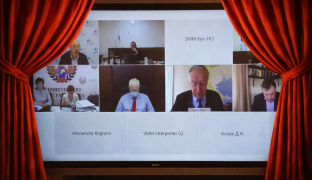
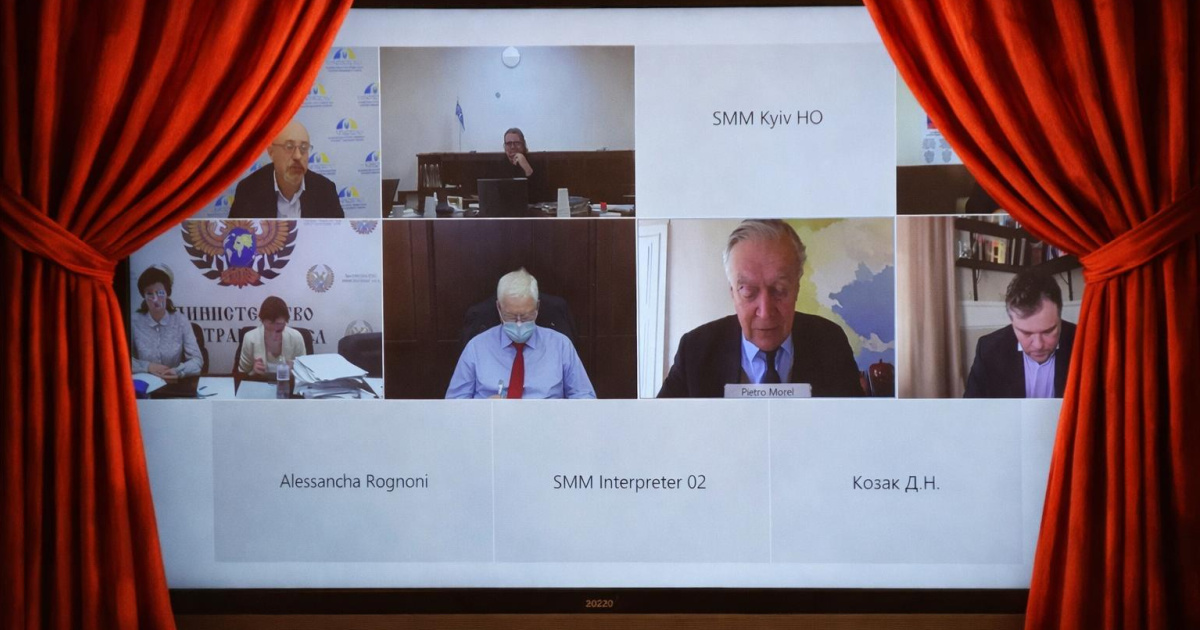
I remember how the start of one of the TCG meetings was delayed due to the absence of the “foreign minister” of the so-called “DNR” Nikanorova. Then she appears on the monitor flushed, fastening the top buttons on her blouse. “Ms. Nikanorova, where have you been?” – asked Ambassador Grau, the OSCE Chairperson’s Special Representative, with a hint of female sarcasm. Nikanorova did not answer. I thought that either she just returned from the beach, or just had sex. At least, that’s exactly how it looked.
However, to begin with, before writing about the Minsk process, it is probably necessary to explain its structure, how it was formed, and what the “Minsk agreements” actually were.
3. "Even if the Americans are unlikely to be pleased..."
The Minsk agreements, or as they are also called – arrangements – were the product of the so-called “Normandy Four”, which, in fact, developed them in 2014.
The Four were Ukraine, russia, France, and Germany, or rather, their leaders and foreign ministers. Then, in 2019, within the framework of the Four, the institution of foreign policy advisors to the heads of state came to the forefront, effectively pushing foreign ministries out of decision-making.
In Ukraine, the foreign policy advisor was the head of the Presidential Office Andriy Yermak. That is, he supervised the entire process starting from 2019.
Formally, the September (2014) Protocol and Memorandum (what is called “Minsk-1”) were concluded without the participation of Berlin and Paris. But in reality, starting from June 6, 2014, when in the Norman Château de Bénouville (France), during the celebration of the 70th anniversary of the Allied landings, the presidents of France, russia, Ukraine, and the Chancellor of Germany met for the first time, the imprint of their “mediation efforts” was already on the entire process of “settling the conflict in eastern Ukraine” (as the hybrid war of russia against us was diplomatically called at the time).
Interestingly, before that, on April 17, 2014, a meeting took place in Geneva between U.S. Secretary of State John Kerry, russian Foreign Minister Sergey Lavrov, Acting Foreign Minister of Ukraine Andriy Deshchytsia, and EU foreign policy chief Catherine Ashton. At that time, they signed the Geneva agreement on Ukraine, which called on the opposing sides to refrain from any violence.
“All sides must refrain from any violence, threats, or provocative actions. The participants of the meeting strongly condemn and consider any manifestations of extremism, racism, and religious intolerance, including antisemitism, as unacceptable.
All illegal armed groups must be disarmed, all illegally seized buildings must be returned to their rightful owners, all illegally occupied streets, squares, and other public facilities in Ukrainian cities must be vacated”.
Even then, long before “Minsk,” this document for the first time introduced “amnesty” for extremists and a “constitutional procedure”.
“All protesters and those who voluntarily leave buildings, vacate other public facilities, and lay down their arms will be granted amnesty. The exception is those who are found guilty of committing serious crimes.
…The announced constitutional process will be comprehensive, transparent, and accountable. It will include a broad nationwide discussion covering all regions and voters of Ukraine and will take into account public statements and proposed amendments”.
If this “appeal”, which moscow also hypocritically signed, had been conveyed by the kremlin at least to the russian citizen Igor Strelkov (Girkin), who five days earlier, together with a group of other russians, had seized the Ukrainian city of Sloviansk in the north of the Donetsk oblast, then the “conflict” could have ended right there. However, in reality, this meeting had no effect on the situation in Donbas. The Obama administration did not want to actively intervene in the conflict, and Berlin and Paris saw this as a chance to strengthen their influence in Europe.
In October 2016, the book by journalists of the newspaper Le Monde, Fabrice Lhomme and Gérard Davet, “A President Should Not Say That…” was published in France.
It was written based on the results of more than 60 meetings between these journalists and François Hollande.
According to it, despite russia’s annexation of Crimea and its organization of unrest in Donbas, Hollande still decided to invite putin to the Château de Bénouville for the celebration of the 70th anniversary of the Allied landings in Normandy. The goal (or pretext?) of this was to arrange a meeting between the russian president and the then newly elected President of Ukraine Petro Poroshenko.
Hollande called this a “peacekeeping mission”. At the same time, the French president held consultations with German Chancellor Angela Merkel, who supported him “even if the Americans are unlikely to be pleased...”.
That is, under the pretext of peacekeeping, the French president spared himself the awkwardness of not inviting the leader of an aggressor state to the celebration.
At that time, putin was effectively in international isolation, and this was uncomfortable for Berlin and Paris, which had for too long tied themselves to russia through energy resources, business, and… opposition to the Americans. They needed to restore relations with the kremlin, but in a way that would allow them to save face and maintain the appearance of “commitment to international law”. The role of “mediators in the peace process” fit perfectly in this case.
At the very moment when putin was redrawing borders in Europe, breaking the world order, and unleashing war in a sovereign country, the leaders of Western democracies… were inviting him to celebrations! Truly, all wars and betrayals are carried out “for the sake of peace”…
So, Hollande sent putin an invitation to this summit. In advance, he warned him that the President of Ukraine was also invited.
— "Does this mean I should not come, that you do not want to see me?" — "No, not at all. I invited Poroshenko, but a lunch and a meeting are planned. Perhaps even contact with Poroshenko..." — the journalists quote Hollande’s account of his conversation with putin.
The French president’s impressions of Poroshenko’s first meeting with putin are also interesting.
"Putin played a tough game", and the newly elected president of Ukraine, according to Hollande, experienced "physical fear".
The conversation took place before the official breakfast at the Château de Bénouville and lasted only about 15 minutes. But the very fact of these talks was assessed by the French president as "without false modesty, a successful move". According to Hollande, by seating putin next to Poroshenko, he forced the russian president to recognize the latter’s legitimacy. But most importantly, thanks to these four-party talks, it was possible to "avoid escalation of the conflict"...
“Avoid escalation,” “prevent escalation” — these words were the mantra of all Western European politicians and diplomats who were in any way involved in the Minsk process. Not “compliance with international law”, not “restoration of territorial integrity” or “punishment of the aggressor”, not solving the problem at all, but stabilizing it — that was the goal of the West throughout all 8 years of the Minsk negotiations.
It is obvious that if a disease is not treated, but only its symptoms are stabilized, the patient has no chance of recovery. In relation to Ukraine — instead of medical intervention, the West at that time preferred dancing with tambourines at the patient’s bedside…
Recently, I heard the opinion that if not for Minsk, putin would have occupied the entire country, including Kyiv, back in 2014. I absolutely disagree with that. In 2014, putin had not even yet thought that such a thing was possible. The annexation of Crimea and Donbas were a testing ground for him. At that time, he was making plans for energy dominance in the world and was doing everything with an eye on the West. In my view, it was precisely the inaction of the United States and the EU, the ineffectiveness of UN institutions, that gradually led him to believe that the democratic world is weak, dependent on russian energy resources, and will “swallow anything”. It was the world’s reaction to 2014 that created the conditions for the catastrophe of 2022.
Poroshenko’s plan, and not only…
But let’s return to the previous topic. Already the next day after the Normandy meeting, in his presidential inauguration speech in the Verkhovna Rada, Poroshenko announced his peace plan for resolving the conflict in the East of the country. Addressing the residents of Donbas, he said:
“With what will I, as President, come to you in the very near future? With peace. With a project of decentralization of power. With a guarantee of the free use of the russian language in your region. With a firm intention not to divide Ukrainians into the right and the wrong ones. With a respectful attitude toward the specifics of the regions. Toward the right of local communities to their own nuances in matters of historical memory, the pantheon of heroes, religious traditions. With a joint project developed even before the elections with our partners from the European Union to create jobs in eastern Ukraine. With the prospect of investments, with a program project for the economic reconstruction of Donbas.
Today we need a legitimate partner for dialogue. We will not talk to bandits. And the current local deputies no longer represent anyone.
And we are ready to announce early local elections in Donbas.
This is my peace plan for Donbas and the whole country”.
It is clear that this peace plan was not born overnight between Normandy and the inauguration. This means that Poroshenko discussed it with Merkel, Hollande, and putin. However, this was not concealed. It would even have been strange if he had not done so, since he needed to secure their support and demonstrate his peaceful intentions.
Therefore, although the Germans and the French were not present at the beginning of September 2014 in Minsk, where the “Poroshenko peace plan” was officially recorded, including with the signature of a representative of russia, Berlin and Paris were already at that time taking the most direct, even key, part in the process of “stabilizing” the conflict…
By Serhii Harmash, editor-in-chief of OstroV