


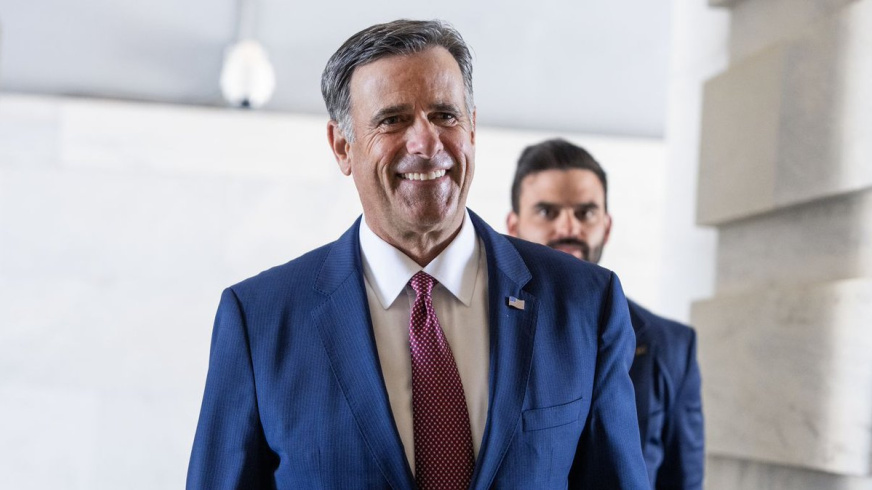
1. Volodymer Zelensky flew to the United States for the high-level week of the UN General Assembly. On the way, at Shannon Airport in Ireland, he held a meeting with CIA Director John Ratcliffe. In New York, Zelensky will meet with Trump. One-hour talks are scheduled.
The meeting with Ratcliffe in Shannon is important because less than a month earlier he had flown to moscow for talks. It is not yet clear whether this meeting was an element of Washington’s pressure on Kyiv ahead of the meeting with Trump, or whether it was about working out options for exchanging Kyiv’s strikes on russian oil refineries for strikes on other equivalent russian targets with the help of U.S. intelligence information. But it is telling that in Kyiv, the priorities of Zelensky’s trip to the United States are said to be air defense, funding for 2027 and the signing of a “drone agreement” with the United States — negotiations with russia on ending the war are not mentioned!
2. On social network X, the president of Ukraine named the conditions for stopping strikes on russian oil refineries: “Ukraine’s energy sector, critical infrastructure and food exports must stop being targets for russia”. Putin’s press secretary Dmitry Peskov said that there had been “no progress” in the talks, expressed hope to resume the trilateral format and promised to make “another attempt to achieve our goals peacefully”.
Zelensky’s statement is an attempt to preemptively protect himself from accusations of disrupting the “energy truce” and to shift the burden of refusal onto moscow. Peskov’s response shows that moscow is still bargaining not over a ceasefire, but over the political conditions of capitulation, and is counting on pushing them through American mediation. The real test will be the russian response to the proposal for a mutual moratorium on energy strikes: agreement would mean acknowledging the vulnerability of oil refining, while refusal would confirm that the strategy is based on the winter destruction of Ukrainian power generation.
3. The EU’s High Representative for Foreign Affairs, speaking on behalf of the European Union, stressed that the EU “does not recognize and will never recognize” either the holding of so-called “elections” in the temporarily occupied territories of Ukraine or their results. This concerns Crimea, Sevastopol and the occupied parts of the Donetsk, Luhansk, Zaporizhzhia and Kherson oblasts. The EU warned that the organizers of the voting and candidates in these territories would be subject to sanctions.
The EU’s promise to personally sanction organizers and candidates for the first time shifts responsibility from an abstract “occupation administration” to specific individuals, including those recruited from local collaborators — this complicates moscow’s staffing of occupation pseudo-structures. At the same time, non-recognition of the results preserves the legal basis for future demands for the withdrawal of troops and compensation.
4. The real result of “United Russia” party in the State Duma elections may have been around 34%, compared with the official 57.8%. Novaya Gazeta Europe calculated the election results using the method developed by physicist Sergey Shpilkin.
Such a low real result indicates declining support for the war among the russian population. The kremlin will have to take russians’ actual sentiments into account when developing its further strategy for the war, mobilization, fiscal policy, etc. This means that the “mandate of trust” “given” by voters to putin’s party could also be used by the kremlin to de-escalate the war.
PS: If, of course, putin is shown the real election results.
5. Acting Prosecutor General Anton Kovalskyi signed an order dismissing Ruslan Kravchenko, the former Prosecutor General, from the prosecutor’s office, who, while retaining his status as a prosecutor, left on a foreign business trip and did not return from it. Earlier, NABU Director Semen Kryvonos stated that there had been a leak of information in the case: the suspects knew about the searches in advance.
The quiet departure of the former Prosecutor General abroad and his “voluntary resignation” is the worst possible scenario for trust in the law enforcement system. Kryvonos’s statement about the information leak reinforces suspicions that efforts to obstruct the investigation came from within the law enforcement system. Given its subordination to the Office of the President, this is a direct blow to trust in Zelensky.