

How do we live? Like in the Werewolf party game, when villagers close their eyes and at night the werewolf wakes up to kill someone.
At night, my mother wakes me up. Or was I already awake? “Are you asleep? They’re shooting!”, she says. The house is rocking. Sleep vanishes.
In these fragments of half-sleep, all sorts of thoughts run through my mind, from what if a shell hits and I’m in my underwear, to whether the window panes will hold or not.
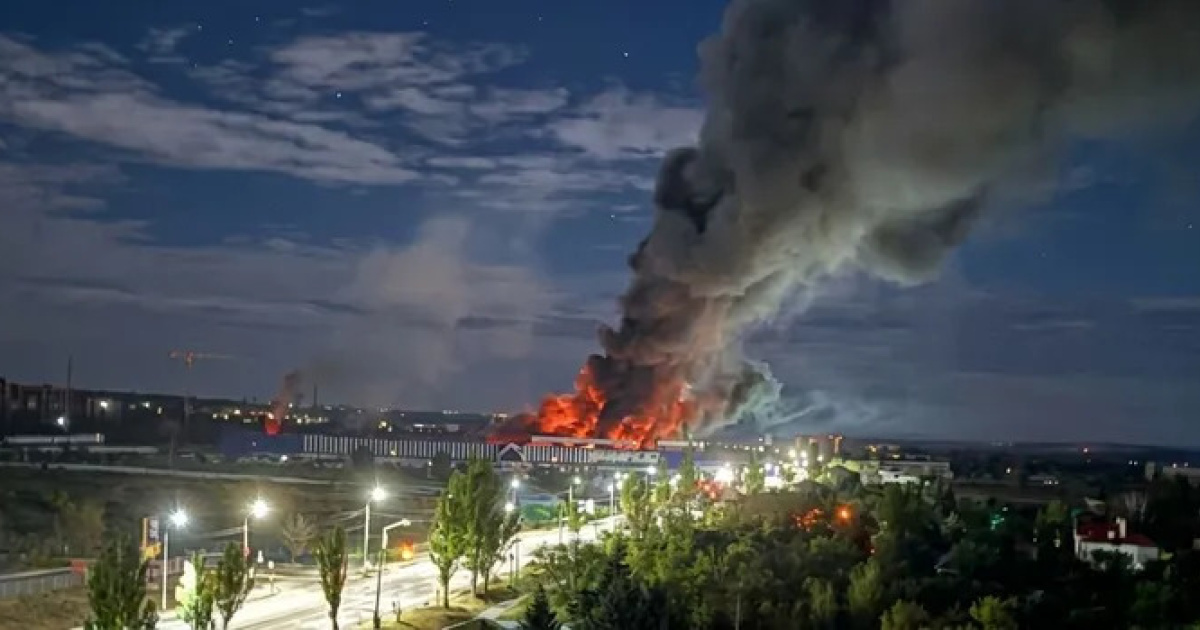
There are a lot of strikes now. We don’t even discuss what happens outside the city—we talk about what happened within the city limits. The locations of strikes are often reported only during the day, as if lifting or pulling back the veil of secrecy. Reports of the dead are reluctant. At work, we speak sparingly about everything. We didn’t sleep. We heard it. We saw the glow of the fires. It was scary. Someone spent the night in the corridor and was exhausted and unwell in the morning after a sleepless night.
Every night is like a lottery now. My mother tries to find a pattern in what gets hit—communications hubs, businesses, factories. I don’t see any logic, but I readily agree with her. The phrase “We walk under God” has acquired a very clear and practical meaning.
I asked an acquaintance of mine in Ukraine about this kind of targeting and in turn he asked me:
– Are you aware that today the russians attacked the platform at the railway station in Dnipro? Fourteen people were killed. And before that, two minibuses were hit in Kramatorsk, with 30 people killed?
– No, they don’t write about that here…
After the tower was hit, it became completely impossible to call an ambulance or get through to a landline. And that, too, is part of the new realities of life now. Some people have been without the Internet for several days after strikes nearby. Everyone is experiencing voltage fluctuations and power outages. The power can be cut during the day, for the whole day; electricity can go out at work, and in the evening it may barely flicker at extremely low voltage. One way or another, we are all experiencing the consequences of the strikes. We realize with surprise that they cannot help affecting us.
At the security desk, a guard whispered a complaint to the cleaner—he had bought materials at Stroytsentr, but they hadn’t managed to deliver them before the store burned down. Now he has to go and file a claim for compensation, which means extra hassle.
We are living in an era of hassles now, in general. As long as a person is alive and wants to live, they are endlessly busy with something. They rush to meet one personal target or another. It invigorates them, keeps them on their toes, and doesn’t let them stand still for even a moment.
If we imagine that someone we know decides to return now and become a citizen of the russian federation, they won’t have to spend days standing in queues, spend days trying to get their place of residence registered in their passport, and then call the multifunctional public services center in the middle of the night to make an appointment. Even now, as I write this, I can hardly believe we went through this whole process—an “LNR” passport, a russian passport, “LNR” driver’s licenses and license plates, and then russian ones. Money, connections, acquaintances, hours in queues, attempts to find “queue runners” who would sell you a place in line.
I wonder, if you add up all the time spent on this, how many hours/days/weeks of a human life did it all take?
By the way, almost everyone keeps their Ukrainian passports. Many people have three passports at once: russian, Ukrainian, and the “LNR” one.
It seems that while the shooting continues, people are simultaneously building houses, dismantling old tram tracks, laying roads, and selling virtual apartments in buildings that have not yet been constructed. If you haven’t been to a particular part of the city for a long time, you see new residential buildings springing up like mushrooms in places where there was nothing for ages. Houses are being built on every vacant patch of land, as if someone had suddenly viewed our city from a completely different perspective—as a collection of plots suitable for construction, investment, and making money.
Concert agencies, medicines, petrol, clothing, food—we have become a new market for goods and services. The bolder ones have started bringing theatre companies here, opening barbershops, and resourcefully offering us things we had grown unaccustomed to. The only catch is that everything brought here now comes with a markup. Like a fee, a duty for living here. A surcharge for life in this particular region.
Every driver knows that it is cheaper to refuel outside the so-called “republic”. Everyone who travels out buys everything from washing powder to household appliances at the nearest russian stores.
It is considered good form to go shopping in russia. To casually mention that you drive to Kamensk or “russian” Donetsk to buy a laptop or minced meat. Not everyone can do that. And while you overpay here, someone else compares prices, saves money, and spends their free time not in theatres but on these shopping trips. And they bring back absolutely everything—cleaning products, coffee, meat, honey.
In general, living here is all about simply staying alive. Leisure, holidays, medical treatment, and shopping are usually arranged outside the “republic”. It is as if the said “republic” exists only for living and working, and often just for living. But for concerts, holidays, and leisurely strolls, there is the vast expanse of russia.
How are we doing? It varies greatly. My mother's pension is 16,100 rubles ($200). That is almost the minimum pension. It is impossible, utterly unrealistic, to live on that amount. You cannot afford to eat properly, buy clothes, get medical treatment, or save anything. And there is no way you can call this standard of living “normal”. Perhaps when they decided on this amount, they reasoned that a pensioner no longer needs anything? Or that every elderly person should have children or grandchildren to support them? Or that people need far less at that age? Or that old age is just one step away from death? I don’t know. But a pension like that is a slap in the face—it means you have been cast aside by life. They have not let you starve to death, but they have given you no chance to live, either. You can look at meat, cheese, and sour cream, but you cannot afford any of it.
Before we became part of russia, some enterprising acquaintances of mine obtained disability status. They got Category III disability, which comes with a monthly pension and benefits. One acquaintance carries a walking stick around with him—for the traffic police. If he gets pulled over, he gets out of the car with the stick and shows his combat veteran and disability certificates. And he has no qualms about playing the veteran card, saying he fought and damaged his health in the process... Even though he doesn’t need the stick in everyday life and keeps it in the car solely for dealing with the traffic police.
Another acquaintance obtained disability status, which gives him the right not to work. It is an investment. A carefully calculated move. A benefit you need to know how to use, like a card up your sleeve.
In general, everything happening now creates fertile ground for those who know how to think several moves ahead. Those who know how to play chess and win. Buying property when it cost next to nothing. Obtaining disability status. Completing a PhD. All of it goes into the pot of future security, an investment in a comfortable old age.
Some of my friends bought a house for next to nothing. The electricity and gas supply had been cut off, the walls were cracked, and the doors were barely recognizable. Someone else would have walked right past it. But it was only a 40-minute drive from the city center. A couple of months later, they moved into the house. They saw that everything could be restored and that there was no need to demolish or completely rebuild the dilapidated little house. This, too, is a small investment in a secure old age, a move made ahead of time. Forest, river, gas, water, electricity, good roads. If you have a car, this is the best option. I could give many more examples like this.
The worst situation now is faced by those trying to play by the rules—to register everything with the tax authorities, run transactions through a cash register, and issue receipts. Those who depend on the system and its new rules. Those walking a tightrope between shutting down their businesses and clinging to a faint hope of staying afloat. Take a walk through the market and you will be surprised. You won't find the familiar vendors or the stalls you have been used to seeing for years. Following all the rules is now unrealistic, and people are leaving the market. They are heading into the unknown or trying to build a new life.
The situation with healthcare is very strange. There are no specialists. No one wants to work in hospitals. There are no prospects. All this is happening against a backdrop of new signs on doors, new chairs, and the obligatory computers for doctors and nurses. It is like theatrical props, an attempt to convince people that everything is fine when things are far from good. Even in the 1990s, it wasn't like this. Even in the early 2000s, it wasn't like this. Now they cannot find a hospital housekeeper or a head nurse, and they are merging departments. A doctor friend of mine complains that whenever she hears the new hospital housekeeper shouting in the corridor, “Don't turn on the TV! Don't walk down the corridor!”, she stays in her office until the woman has left.
In a single day, I see three men without legs. Yesterday, one was standing, leaning against the wall of a supermarket. What is the right thing to do? Pretend you don't notice? Or act as if this is normal? Avoid staring? But I can't manage it—when I walk past, I fall silent. On the Stakhanov–moscow bus, there was a boy with a prosthetic leg. A teenager. He certainly hadn't been to war. He was sitting, and beside him stood his detached prosthesis, reaching above the knee. When you see something like that, you freeze, as if paralyzed. We all walk under God's watch, but now this phrase has an entirely new meaning and almost physical weight.
I know people whose houses burned down back in 2014. Twelve years is a very long time, yet they are still without homes. They live wherever they can, having managed to acquire a few belongings and some clothes. Everything is secondhand, donated, given away because someone else no longer needed it.
I haven't come across any happy people. They struggle along, they live, but they simply no longer have the strength to live as they did before. Their strength has been spent standing in queues, trying to hold their ground and make their presence known. On the hope of receiving compensation. On attempts to rebuild some semblance of their former lives. Conversations bring up memories of what things were like before the fire, of how they used to live. It takes enormous reserves of strength to move on and build a life without constantly comparing it to the past. You would need some tremendous inner resources, and I haven't encountered anyone who has them.
The richest house on our street belongs to a young couple. They have their own business. They travel, buy cars, and renovate their house. Many houses have recently been bought with money earned by husbands who are fighting in the war. Some people dream of selling their houses and moving to russia. “I've had enough of this place”, they say. By “had enough”, they mean rising prices, an endless stream of new requirements, the high cost of living, and shelling.
As we go to bed, we realize that it's a lottery. We no longer live in a safe place. Once again, we fear for our own lives and those of our loved ones. And we don't understand what comes next. Or where to run.
By Olha Kucher, Luhansk, for OstroV