


The practice of hybrid negotiations on a
hybrid settlement of a hybrid conflict
How it happened
“I didn’t think it would be this informal”. That was how Deputy Head of Ukraine’s delegation to the TCG, Oleksandr Merezhko, described his first impressions of Minsk-online. He is the chairman of the parliamentary committee on foreign affairs, an international lawyer, and a professor. But he too, like us, the IDPs, entered the process during the COVID period, when consultations were already being conducted via Zoom, and what he saw also did not match his ideas of diplomatic negotiations...
Let me first explain the structure of the negotiations: from June 8, 2014, to February 2022, there existed the OSCE-created Trilateral Contact Group — representatives of Ukraine, the OSCE, and russia. During my time in the negotiations, it met every two weeks. Sometimes on an emergency basis. At TCG meetings, the heads of the delegations discussed all issues related to implementing the Minsk agreements and made decisions. And for the “implementation of the relevant aspects of the Minsk Agreements”, that is, to develop options for those decisions, in February 2015, during the russian Debaltseve operation, Minsk-2 (the Package of Measures for the Implementation of the Minsk Agreements) established working groups. There were four such groups: “political issues”, “socio-economic issues”, “security” and “humanitarian issues”. I was a member of the political group.
The working group
Meetings of the working groups of the Trilateral Contact Group were always held on the eve of the TCG itself, which listened to reports from OSCE coordinators about what had taken place and what conclusions had been reached. After that, the TCG either approved them by adopting the relevant decision or issued instructions for further work on disputed issues.
To participate in the political subgroup, we gathered in the parliamentary office of Ukraine’s official representative in it, Andriy Kostin. At that time, he was the head of the Verkhovna Rada Committee on Legal Policy (from July 2022 to October 2024, he served as Prosecutor General of Ukraine). The office was located in the new building at 3 Sadova Street, opposite the Cabinet of Ministers. I don’t know how much money was stolen during the construction of this parliamentary complex, but in summer it was unbearably hot, and in winter even an electric heater could not save us. Sometimes, during breaks or during the boring, lengthy speeches of the russian representative, I would sit right on the floor next to the heater to warm up.
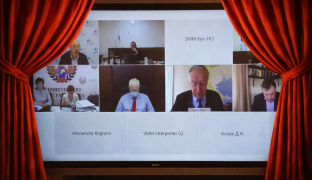
So: a large table, and in front of us an ordinary laptop with a camera. To make sure everyone fit into the frame, it had to be placed quite far away. Therefore, when six windows appeared on the laptop screen, the image was small, and it was rather difficult to make out the emotions of your counterparts.
In one window was the OSCE moderator. When I entered the negotiation process, it was Ambassador Pierre Morel, a Frenchman. A distinguished gray-haired old man. He sat against the backdrop of some doorway. For some reason, I imagine it was in his villa in the South of France. I don’t know why I had that impression: perhaps someone mentioned it, or perhaps I myself “sent” the old man to Provence, where he would have looked perfectly natural in white trousers and a wide-brimmed straw hat. From 1992 to 1996, Morel served as France’s ambassador to russia.
An interesting fact — fate crossed my path with Morel a year and a half before my participation in the TCG. In February 2019, at the very beginning of the pandemic, the French Embassy organized a trip to Paris for a small group of Ukrainian journalists. The topic was precisely the Minsk Agreements.
Among many meetings, we also had a conversation with Ambassador Morel at the French Foreign Ministry. He remained memorable to me for two reasons. First, the diplomat did not hide his irritation with our skepticism regarding the effectiveness of the Minsk Agreements. His tone was predominantly instructive. And when we talked about France’s overly soft position toward russia, he became irritated and arrogant. At the time, this surprised me — I believed diplomats did not show their emotions.
The second point was the argument Morel used in favor of “Minsk”. It came up in the context of a story about the ambassador’s heroic efforts, when he would board a plane in the middle of the night and fly somewhere (I no longer remember where) to help settle the conflict. The emotional climax of this “epic” was the phrase: “Whatever the case, after that, fewer children were being killed in Donbas”. At the time, I did not want to escalate the conversation, but internally I countered: they were being killed more; it’s just that while you are “stabilizing” the conflict rather than ending it, their deaths are spread out over time and therefore less noticeable...
I do not think Mr. Morel even remembers that meeting, but its tone carried over into his attitude toward the representatives of the displaced persons in the TCG. Our appearance in the process was clearly perceived by him as a problem. “Good afternoon, Mr. Kostin!” he would say when opening the working group meetings. The fact that Mr. Harmash, Kazansky, Goran, or Libster were sitting next to Mr. Kostin was something this diplomat demonstratively chose not to notice.
In general, we considered Morel’s position in the negotiations to be rather pro-russian. Therefore, we looked forward to the end of his term. Although on international diplomatic platforms, for example when speaking at the OSCE, Pierre Morel gave objective assessments of both russia’s behavior in the TCG and its role in the conflict in Donbas.
This two-facedness reflected the conflicting interests of all foreign diplomats involved in “Minsk”. At the public diplomatic level, they tried to maintain objectivity. But in the working process, they sought to achieve “progress” in the negotiations at any cost. And, for the most part, Ukraine was the one paying that “price”, to its own detriment.
The fact is that financially and professionally, OSCE representatives were interested in ensuring that the process continued rather than being blocked by one of the parties. Because a deadlock in negotiations was also a reflection of their professionalism. They were interested in keeping the show going, a show in which they had their own well-paid roles. Accordingly, working-group moderators often tried to push us toward concessions to russia simply so the negotiations could demonstrate “progress”. There was no point in pressuring moscow, so they pressured us instead. And russia constantly took advantage of this.
But, for the sake of fairness, this was not only Morel’s problem. In other working groups there were moderators who were far more pro-russian; I can only write about those whom I observed directly and for the longest period.
In the summer of 2021, Morel was replaced by another French diplomat, Ambassador Sylvie Bermann. Also retired. She sat in front of bookshelves and... a traditional russian samovar. Apparently it was brought from russia itself, since, like Morel, she had also once served as France’s ambassador in moscow.
This small detail — the samovar — showed how far removed the OSCE representative was from understanding the conflict she was supposedly “resolving”. For us, it was not simply a device for heating water, but a declaration of her sympathies.
Of course, one could say that not only russians drink tea from a samovar. But then again, the swastika was not invented by German fascists either, yet it is associated specifically with them...
Moreover, Ms. Bermann knew russian much worse than Morel did, the language in which the negotiations were conducted, which often created communication problems: she misunderstood something, or one of the participants misunderstood her...
The next window on the screen was Rodion Miroshnik. Always with a swollen face. Sometimes very swollen – a sign of issues either with alcohol or with his kidneys. Though probably with both. The representative of the “certain districts of the Luhansk oblast” had long lived in the capital of russia, and therefore defended the interests of his provincial countrymen from a moscow apartment. He also sat in front of bookshelves, but of a Soviet-style design — as if above a kitchen corner bench. Or perhaps he actually was sitting in the kitchen, wearing underwear and a blazer in front of a webcam. At least his loose, casual manner of speaking painted exactly that picture in the imagination.
By contrast, “Ms. Mikhailova” — the “authorized representative” of the CDDO / “DNR” — always appeared on screen with an air of “officialdom”: freshly styled hair and a backdrop bearing the words “Ministry of Foreign Affairs of the DNR”. These words were placed beneath a large image of a two-headed mutant bird, apparently the incestuous offspring of the russian double-headed eagle. It looked amusing because Mikhailova sat right in the middle, making it seem as though the two chicken-like necks were growing directly out of her head like horns.
The representative of CDDO was usually accompanied by two men — “public experts”. What kind of expertise they provided her is unclear, but clearly not linguistic, since throughout all the time I participated in the negotiations I never once heard their voices.
The fourth window also showed a man and a woman. Also “public experts”, but from CDLO / “LNR”. Unlike the Donetsk ones, they had an intelligent appearance. And they were also there purely as decoration.
They, like Mikhailova’s “public experts”, appeared at the beginning of 2021, after we — the displaced persons — were included in the Ukrainian delegation. This was a reciprocal move, and also in response to us — so to speak, for balance. The reason for their presence in a separate window (unlike the Donetsk “experts”) is simple: Rodion Miroshnik was too lazy to fly from moscow to Rostov every two weeks and then still drive to Luhansk to work with them in the same room. Therefore, the OSCE, disregarding confidentiality rules, gave outsiders a separate entry point, without asking the consent of the TCG participants.
At first, the Ukrainian delegation filed protests regarding this. But later, for some reason, we stopped objecting both to the appearance of these “public experts” and to the fact of their separate window.
All this was overshadowed by the appearance in the negotiations of Maya Pirogova. She is a top propagandist of the “DNR” and a fraudster (literally), previously convicted multiple times in Ukraine even before the war. But our leadership refused to sit at the negotiating table with her (even if only virtually), not even because of that. After 2014, a Ukrainian court sentenced her to 10 years for terrorist activity. And negotiating with a terrorist is too much even for us. Her appearance even temporarily blocked the work of the political subgroup. However, later, when the russians grew tired of inventing reasons why they did not want to open entry-exit checkpoints in the Luhansk oblast despite previously reached agreements, she was transferred to the humanitarian subgroup, which in turn temporarily blocked the work of the humanitarians.
But because of this, the political subgroup resumed its work. And everyone was so relieved by the “Pirogova problem” being solved that they decided to no longer notice either the appearance in the process of people introduced by unknown parties, or the fact that they were shown in separate virtual windows, or the violation of the confidentiality regime of the negotiations.
By the way, this is a typical russian tactic: when they want to push something through, they artificially create a problem unrelated to it. And then they supposedly make concessions on resolving that false problem. In exchange, they demand concessions on what they actually care about. In our case, it was the introduction of outsiders into the negotiations in order to lower the status of the “CDDLO representatives” from Ukraine — that is, us. Naturally, a conflict arose — we were against it, since officially these people are not listed in any delegation of TCG members. And then, to divert attention from this issue, the russians create another problem — Pirogova, who blocked the work of two working groups. And when the second problem is “solved” (Pirogova disappears due to “health reasons”), the first problem (outsiders in the negotiations) no longer seems important enough to continue confrontation over. As a result, russia achieved what it originally wanted. Through such methods, they effectively restructured the negotiations to suit themselves. And Ukraine and the OSCE, interested in keeping the dialogue going, allowed it in order not to block the “diplomatic solution to the conflict”.
Another window on the monitor showed the Administration of the russian president, “Mr. Alexei Dmitrievsky”.
This man has a disturbing tendency to enjoy listening to himself. He speaks rarely, usually at the end of the meeting, claiming some sort of right to assess its participants. Always praising the “DNR-LNR”, and always negative toward Ukraine. But his speeches are so long and “deep” that we sometimes wondered: does he himself understand what he is saying, or does he simply enjoy the sound of his own voice?
In general, Dmitrievsky’s participation boils down to the phrase: “The russian federation supports any agreements reached between the parties to the conflict: Kyiv and Donetsk with Luhansk”. At this point I always had the question: why are you even needed here if you are satisfied with “any”(!) agreements that do not involve you?
Moscow persistently tries to present itself as a zero, but a zero that, when added to “DNR”/“LNR”, would turn into a ten and determine everything not in Ukraine’s favor.
The russians say their role is that of a second mediator, alongside the OSCE. But mediation presupposes objectivity, and russia has never once supported Ukraine; it has always been exclusively on the side of its representatives from CDDLO. Moreover, Ukraine never gave consent to its “mediation”, calling russia a party to the conflict. Not to mention that the members of the TCG are Ukraine–OSCE–russia, and everyone else are merely “invitees”. And this is a fact recorded in the Minsk documents. Therefore, other opinions are nothing more than verbal diarrhea from Mr. Dmitrievsky, who is also its main consumer.
That is what meetings of the working groups looked like. Although each group has its own composition, and accordingly its own Morels, Miroshniks, and Dmitrievskys. Some more adequate, some less...
TCG meeting
As a rule, the day after the working group meetings, a meeting of the Trilateral Contact Group itself takes place. In my case, that is, since 2020 — also online.
For it, we gather in the office of Vice Prime Minister Oleksii Reznikov in the building of the Ukrainian government. A large table, and in front of it a huge monitor. Unlike Kostin’s office, there are no climate control problems. Plus, in the reception area there is a coffee machine with good coffee and a friendly secretary. In general, the atmosphere is much more comfortable. And there are more people — which makes it more interesting.
First, before the TCG meeting, a brief conference is held between the head of the delegation and the heads of the working groups. They report on the results of the previous day’s meetings, share their thoughts on what the TCG should pay attention to, what points should be emphasized, and so on. All of this takes place behind closed doors. While they are conferring, all the other delegation members and guests (more about them later) sit in the reception area and wait. Then the meeting itself begins, and the participants of the working groups currently reporting enter the office. The others either wait in the reception area or arrive specifically for the report of their own working group. Although the schedule may shift, everyone tries to stay somewhere nearby.
The TCG meeting began with the so-called “closed session”. This was when the heads of the russian and Ukrainian delegations, as well as the Special Representative of the OSCE Chairperson-in-Office, communicated tête-à-tête. I do not know how it was directly in Minsk, but in the online format, during my time there, they were tête-à-tête only on the screen. In reality, behind the scenes in the OSCE office, in moscow, and in our office, there were always other people present: from Foreign Ministry staff providing protocol support (that is, preparing document texts, decisions, recording dates, and so forth) to anyone whom the head of the delegation (in our case, Kravchuk, Reznikov, or Kostin) considered useful to have nearby. This could both be seen and heard from the monitor.
When I joined the delegation and Reznikov was leading it on our side, ordinary members of the team were not allowed into the closed session. When Kravchuk became head of the delegation, he apparently, without fully understanding the procedure, invited everyone who was waiting in the reception area. From that point on, I also began attending the closed sessions.
Although this was my personal initiative, the other “CDDLO representatives from Ukraine” continued to come only for the report of their subgroup. I was simply interested in everything that was happening, in the entire process, so gradually, and as I established contacts with people, everyone apparently became accustomed to the fact that I was present even in places where I was not supposed to be.
During these closed TCG sessions, the head of the russian delegation, Gryzlov, every single time (!) demanded that the OSCE also invite the “representatives of Donbas”, Nikanorova and Deinego, to the dialogue. And every single time Ukraine refused to agree. It became a kind of ritual with which every TCG meeting began.
Why was the presence of the “representatives of Donbas” in the closed session so important to russia? Because it was a diplomatic trap! According to all the documents, the Trilateral Contact Group consisted of the OSCE, Ukraine, and russia. The meeting of the heads of their delegations was the TCG. Everything else was the TCG members listening to reports from the working groups, whose members were merely “invited” to participate. Therefore, the participation of the “ministers” of the “DNR” and “LNR” in the meeting of the TCG delegation heads would have meant recognition by Ukraine and the OSCE that they were not invitees but equal participants in the TCG — that is, parties to the conflict. Which, in fact, was moscow’s main objective in these negotiations. And something we could under no circumstances allow, because it would have removed all responsibility for the conflict from the RF and, accordingly, the sanctions as well.
It should be noted here that precedent is extremely important in diplomacy. In other words, if through some oversight or inexperience on the part of the delegation leadership we had agreed to this even once, we would later have had no opportunity to reverse it. The “ministers” would indeed have become de facto members of the TCG, the “republics” would have become recognized subjects of the conflict, moscow would have become a mediator in the negotiations, and the conflict in Donbas would have become an “internal” one.
I emphasized this aspect in order to illustrate why, at least by the time I entered the process, the negotiations had reached a dead end in terms of format: one side to the conflict did not recognize itself as such, while the entities that moscow called the “parties” were not recognized as subjects by either Ukraine or the OSCE. At the same time, in terms of participation in the negotiations, the “Donbas republics” were (not de jure, but in practice) effectively treated as subjects: they brought their own people into the negotiations, meetings would not begin without their representatives, and even on the monitor they were labeled as “DNR” and “LNR”, rather than CDDLO, which was how they were designated in the Minsk documents.
We, meanwhile, ignored this so as “not to disrupt the dialogue”. All of this was the consequence of precedents — that is, isolated mistakes previously made by the Ukrainian and OSCE delegations, which led to such a massive distortion of the format of the negotiation process.
There were occasions when the expanded TCG session did not begin because Nikanorova was absent. Former Speaker of the russian State Duma Gryzlov, the first President of Ukraine Kravchuk (or Ukrainian Vice Prime Minister Oleksii Reznikov), and an international-level diplomat — the Special Representative of the OSCE Chairperson-in-Office — would sit and wait for some Nikanorova, who formally was not even a participant in the negotiations. I suspect she was deliberately late in order to emphasize that nothing would begin without her, to show who the real subjects were and who were merely objects.
This was almost certainly done on moscow’s instructions; otherwise, such disrespect toward Gryzlov would have been viewed as disrespect toward russia.
Several times, as I recall, the leaders of our delegation suggested not waiting: “All members of the TCG are present. Let’s begin!” But this was always more of a mischievous gesture than a serious demand. Moscow always objected, the OSCE did not support us either, and we swallowed this humiliation from a self-proclaimed “minister”.
But let us return to the TCG meeting. So, after the closed discussion among the heads of the delegations, the “representatives of Donbas” (“ministers” Nikanorova and Deinego), the moderator of the first working group reporting to the TCG, and the participants of that working group from the “sides” were invited to join.
The moderator would present a brief summary of the previous day’s meeting of their group. Then, if someone disagreed with the report, the heads of the delegations or the representatives of the sides in that working group would take the floor. Clarifications of positions, complaints, accusations, and so on would begin. For the most part, this platform was used by the “representatives of Donbas”. More precisely, they used it every single time! Their main task was to demonstrate their subjectivity, and to do that they had to speak constantly and state their position. It did not matter what that position was or how constructive it might be; the important thing was to speak. According to the principle: we speak, therefore we exist.
And one more detail to describe the atmosphere and format. Starting sometime around the autumn of 2020, various people began coming from our side to observe the negotiations. The most regular attendees (that is, they came to almost every TCG meeting) were representatives of religious denominations: the Greek Catholic Church and Muslims. A couple of times, some man apparently from the OCU also appeared. On the very first occasion, there was also someone from the UOC (Moscow Patriarchate). But either the Orthodox representatives did not like the company, or they found it boring — in any case, we never saw them again. Meanwhile, Andriy from the UGCC and Rustam from the Muslim community quickly became what you would call part of the team. They were interesting to talk to, and Rustam also brought along an entire bag of nuts and Eastern sweets. For us, sitting there hungry for six to eight hours, it was naturally difficult not to become interested in the Quran after that.
For some time, former Member of Parliament and, at that point, environmental adviser to the Office, Yehor Firsov, was also present in the room. Apparently, this was connected to the idea of creating another TCG working group — one on environmental issues. Such an intention was even announced, but then, for some reason, it never materialized.
At the final meetings, when the delegation was already headed by Andriy Kostin, members of parliament also began attending. They were from the Servant of the People party and used the Minsk topic for publicity. But these were one-time appearances. As a rule, they sat quietly; some actively offered advice to the head of the delegation. Most of it was pointless, but everyone pretended to listen because if they were there, it meant they had been sent by the Office of the President.
At first, the presence of outsiders irritated me. It felt as though you were on stage and being judged. But now, at least regarding the religious figures, I think it was the right thing. Both the Vatican and the Muslim world could understand firsthand, rather than through someone else’s account, that we were not the ones blocking the conflict-resolution process. In other words, these people were a resource. One of the few resources available to our weak state in these “hybrid” negotiations.
Behind the scenes
There was also another non-public aspect of the Minsk negotiations. Our delegation, like the entire process, had its own backstage area. It was located in the lounge within Vice Prime Minister Reznikov’s office, where the online TCG meetings took place. There, on a soft couch, sat Ruslan Demchenko during almost every meeting. At the time, he was the First Deputy Secretary of the National Security and Defense Council, an adviser to the President, and head of the Intelligence Committee under the President of Ukraine.
I never saw him arrive there during a TCG meeting itself (except for one occasion when a strict gray overcoat and a leather briefcase quietly passed by almost unnoticed). This suggests that he always arrived long before the negotiations began. He also left only after most members of the delegation had already gone home.
To be honest, I still do not know what he was doing there. He could, of course, hear what was happening, but the door was usually closed. And even when it was open, it would have been far more convenient to observe the process directly from the room where the monitor was located.
Maybe he had some kind of live feed there, but judging from what I saw when I came in — no. At the same time, everyone knew he was in direct contact with Yermak, so any serious issue that arose during the process was discussed by Reznikov, Kravchuk, and those they needed — precisely in the lounge.
Once, when Reznikov (who usually listened to my ideas) was absent, I went to Demchenko with one of my proposals. The Deputy Minister of Defense and our representative in the security subgroup, Oleksandr Polishchuk (since 2023 acting as an Ambassador of Ukraine to India), happened to be there.
Demchenko listened and said: “Good idea, but why are you coming to me with it, talk to Kravchuk, he is the head of the delegation”. I answered: “But he’ll still come to you with it anyway”. Demchenko and Polishchuk exchanged smiles.
But in general, after each TCG meeting, the head of the delegation (or whoever was substituting for him), Reznikov, Oleksiy Arestovych, and I would go into Demchenko’s little room. Together we would draft the press release on the results. Rather, Arestovych would read out the basic outline, I would suggest what I thought should be emphasized, and make purely editorial corrections.
Arestovych was the delegation’s adviser on information policy, and often his task in this fruitless process was to say something in such a way as to say nothing at all. I, as a journalist, tried to bring at least some specificity into the texts so that the media would have something to turn into at least headlines.
However, our texts were further edited in the Office of the President (which is logical, since they were first published on the website of the President of Ukraine), so sometimes something appeared in them that had not been discussed in the lounge.
And there was also an obligatory requirement: every statement had to contain something positive. Even if there was nothing positive, people had to see a positive dynamic in these negotiations. So sometimes phrases appeared like: “progress was observed and agreement was reached to continue agreeing further”.
Interestingly, Demchenko’s appointment as First Deputy Secretary of the National Security and Defense Council took place on June 16, 2020 — that is, almost simultaneously with our (the displaced persons’) entry into the process (June 9, 2020) and the subsequent inclusion of former President Leonid Kravchuk and former Prime Minister Vitold Fokin. This gives grounds to consider him one of the elements of the “reboot” of Minsk under Zelensky–Yermak.
A process that had previously been more technical and opaque, even peripheral for the Poroshenko administration, was turned by the Zelensky Office (which had promised to end the conflict in Donbas within a year) into one of the pillars of its public policy.
Or rather, not a pillar — but a showcase. Because it was made public mainly by us, the newcomers who joined the delegation, through our media activity. The Office itself did not really welcome publicity, which is why it introduced Oleksiy Arestovych as adviser on media work. He described his role on his Facebook page as the “single voice of the delegation”.
According to Bankova’s plan, he was supposed to centralize all public communications around himself. But this was simply impossible for both objective and subjective reasons.
For example, I could hardly refuse dozens of journalists who, after every TCG meeting (or even during it), would call and ask what had happened there. There was no direct and official ban from the Office on communicating with the media that I could refer to. And if I refused without explanation, it would look like I was personally hiding something from colleagues...
Besides, given my relatively low status in the delegation, the media was my only safeguard in case decisions were made that I in no way wanted to be involved in and could not influence. I simply reserved for myself the right to appeal to the public.
That is why — and not out of a desire for publicity (as some in the Office of the President thought) — when Oleksiy Arestovych came on his first day of work (October 2020) and said that he was the delegation’s adviser on media relations and would now take over all communications, I thanked him for his help and promised to reach out if I needed advice in that area. After all, “single voice” does not mean “only voice”. That was the end of the media communications topic between us. Seeing no point in hostility, we began to cooperate. Since he had direct access to the Office of the President (in fact, he was constantly there), I sometimes discussed with him ideas I wanted to convey there. In turn, he always called me after meetings of the political subgroup, and I would describe what had happened, from which he would prepare his media statements.
In general, we almost immediately found a model of effective cooperation. Although our views on certain aspects of the negotiation process and conflict resolution did not always coincide. Once, at the beginning of his work in the delegation, we specifically met in a café to talk and clarify each other’s positions. Back then, Oleksiy said, as if it were self-evident, that in the end we would still have to talk to Donetsk and Luhansk. I didn’t even voice my disagreement. Why spoil relations if that “someday” might never come? When it comes, then we’ll cross that bridge. In general, whatever is said now about Arestovych, his position in the delegation was, in my view, constructive. At least he did not interfere with me.
Although within the Office itself, attempts to control information coming from the delegation continued. Once, a young woman from the Office came to a TCG meeting. She approached me and started demanding something in a lecturing tone… To be honest, I don’t even remember what exactly, because I didn’t pay much attention to her at the time. So many people were coming and going: priests, interns from the Foreign Ministry, MPs, civic activists. In short, an unknown young woman from the Office showed up, insisting that I had to coordinate something with the Office, that they were professionals in PR, and so on. I thanked her and politely replied that if I ever needed professional help in public communications, I would definitely reach out. It was clear she was unhappy with that answer, but I had already turned my attention to a conversation with Kravchuk, who was passing by…
It was not that I was intentionally positioning myself in opposition to the Office of the President. It’s just that, first, she chose the wrong tone for an introduction, and second — I simply did not know that she was an influential (as I later read in the media) aide to Yermak. Moreover, at that time I simply did not see Office staff as authorities in the field of PR. This is not arrogance, but the result of two factors: my twenty years of experience in journalism, and the fact that the Office had only recently been formed — its people simply could not objectively yet be authorities for me. Authority is not attached to a position; it is earned. At that moment, they were amateurs and upstarts to me. As, apparently, I was to them. And if you add arrogance to amateurism, with which I was being “put in my place”, then my reaction should be understandable.
In general, attempts at direct control failed. But that does not mean there was no control. It was simply carried out in more refined, “diplomatic” forms. For example, one of Reznikov’s assistants told me that Yermak, when he disliked something coming from us in the media, would simply send links to those posts to the Deputy Prime Minister without any comments — as if to say: “look what your people have said again”. In this way, he would effectively shift responsibility for our actions onto him.
To Reznikov’s credit, he never mentioned this and never tried to hold “educational talks” about it.
But an adviser in the Office of the President, Viktoriia Strakhova, who referred to Yermak exclusively as “the boss” and represented Ukraine in the economic subgroup (after Yuliia Svyrydenko moved up), once — I no longer remember after which of my media activities — gently warned me: media monitoring has not been abolished…
However, the Office’s attempts to control information flows from our delegation also had objective reasons. It is enough to note that they began (the appointment of Arestovych as the delegation’s adviser on information work) after the scandals involving Vitold Fokin, the First Deputy Head of the delegation.
A month and a half after his appointment, at a parliamentary committee meeting, he “suddenly” stated that he saw no evidence that a war between Ukraine and russia was taking place in Donbas. This caused a serious political scandal and created tension within the delegation itself, where such views were probably shared by at least one other person, although he never publicly stated it. But more on that later...
In general, this entire information inconsistency created a lot of internal political problems, so something really had to be done about it. By the way, even before Arestovych joined the delegation, after I had released information to the press based on Yermak’s words about a forthcoming meeting of the N4 advisers — which supposedly almost derailed it — I developed rules for communication between delegation members and the media. They were very simple. Reznikov, who headed the delegation at the time, agreed to them, and for a couple of meetings we even followed them. But then our “elders” spoke up, and no rules could stop them anymore (I am not even sure they were told about them at all). And once one person broke the rules, everyone else stopped following them as well.
By Serhii Harmash, editor-in-chief of OstroV